Your Firm Is Doing Excellent Work That Clients Cannot Find Online
SEO for accountants is the process of positioning your firm in front of people who are actively searching for the services you already provide, at the moment they are ready to hire.
According to BrightLocal’s 2024 survey, 42% of clients now find their accountant online. If your firm is not appearing in those searches, that work is going to a competitor who is.
Is your firm visible to the right clients online?
Four questions. Takes 90 seconds. Find out where your search presence stands.
When a business owner in your area searches for an accountant, where does your firm appear?
How do most new clients currently find your firm?
Does your website have separate, dedicated pages for each service you offer?
How is your Google Business Profile set up for local search?
Your current setup is not generating organic enquiries
Based on your answers, your firm has a limited online presence and is likely invisible to the 42% of clients who search for an accountant before making contact. With client lifetime values ranging from 5,000 to 240,000 pounds, each month without a functioning search presence represents a measurable cost to the practice.
You have a foundation, but gaps are reducing your enquiry volume
Your firm has some online presence, but without dedicated service pages, a fully optimised Google Business Profile, and consistent local authority signals, you are likely losing enquiries to firms that have invested in their search infrastructure. Local SEO improvements at this stage typically produce results within three to six months.
You have a solid baseline and are positioned to scale enquiry volume
Your firm already has the structural foundations in place. The next step is moving from passive visibility to active acquisition, which means identifying high-demand service niches in your area using search data, building authority through relevant backlinks, and integrating your SEO activity with a conversion-focused website structure.
Search acquisition infrastructure for accounting firms
These are not isolated tactics. Each component is part of a connected system designed to move a firm from referral dependency to predictable inbound enquiries.
Niche Positioning and Search Architecture
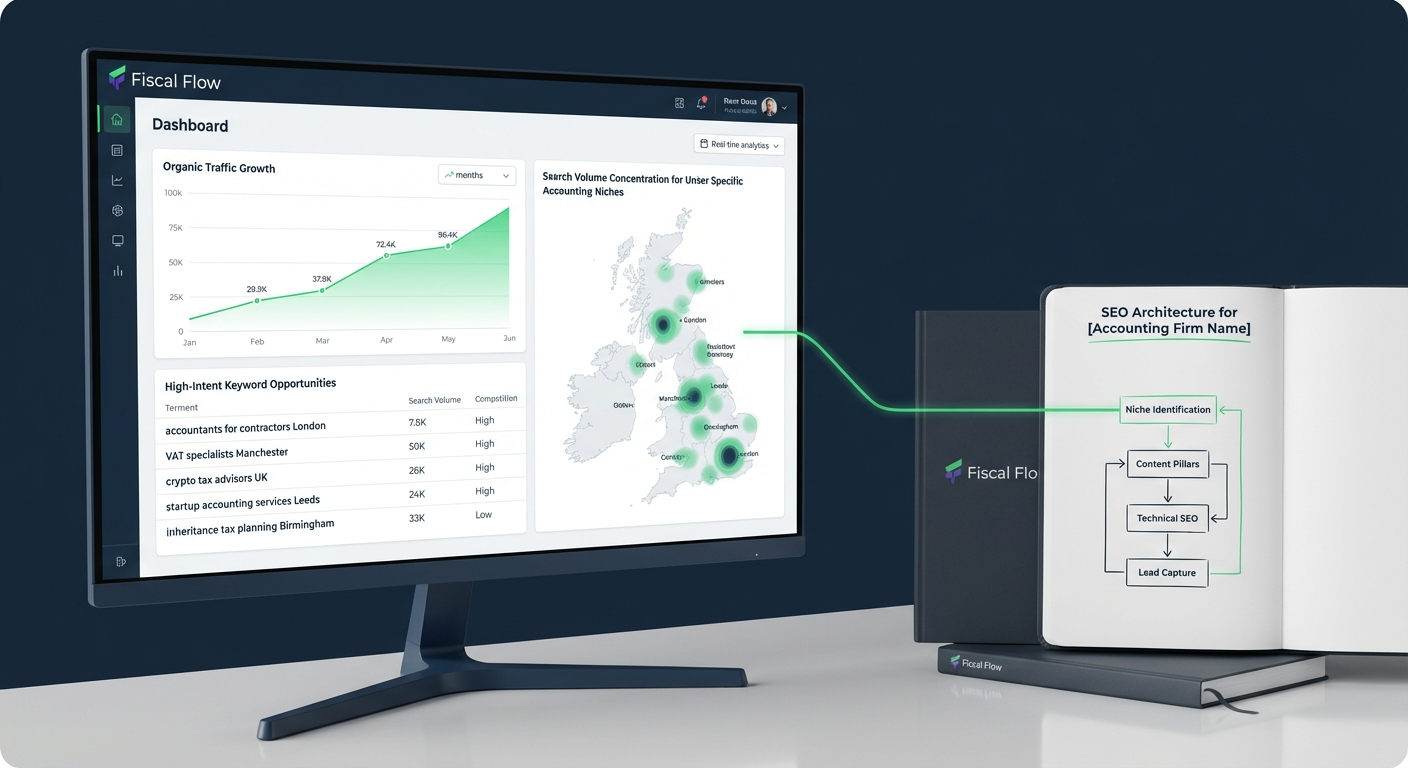
Fiscal Flow uses national business registry data alongside Google search data to identify the highest-demand service niches in your area before any content or landing page is built. This means the SEO architecture is designed around real search demand rather than assumptions about what your ideal clients might be searching for.
Search Strategy
Service Landing Pages and On-Site SEO
Each core service your firm offers is built into a dedicated, search-optimised landing page designed to rank for high-intent terms and convert visitors into enquiries. Creating service-specific pages is one of the most direct improvements a firm can make to both search rankings and conversion rates.
Technical SEO
Authority Building and Backlink Development
Search rankings for professional services are influenced heavily by backlinks from authoritative sources, including tax platforms, corporate law sites, and accounting software providers. Fiscal Flow builds this authority profile in a way that is appropriate to a professional practice, avoiding the aggressive tactics that can damage a firm’s online reputation.
Authority
Why this approach works for accounting practices
Generic SEO agencies apply the same framework to every industry. Fiscal Flow is built exclusively for accounting and CPA firms, which changes the depth of what is possible.
Accounting-specific demand data informs every decision
Because Fiscal Flow combines national business registry data with Google search data, the niche and keyword targeting is based on verified local demand rather than generic assumptions. This removes the guesswork from the initial strategy and reduces the time it takes to generate qualified enquiries.
A complete system rather than an isolated service
SEO activity is only valuable if the traffic it generates converts into clients. Fiscal Flow connects search acquisition to CRM automation and digital onboarding workflows, so new enquiries are handled efficiently without increasing administrative work for the practice.
Built for professional services, not volume markets
The UK accountancy market is valued at 39.8 billion pounds and includes over 408,000 professional members across chartered bodies. Positioning within that market requires precision around service, location, and client type. Fiscal Flow’s framework is designed around that specificity rather than broad traffic volume.
What our clients say
“Generated a large number of leads for our business which we could never have reached or managed on our own.”
“Great persistent marketing with good long term results.”
“Since starting with Fiscal Flow last year, we have now seen a few clients added to our portfolio. Great ROI.”
How the engagement works
A defined four-stage process from initial audit through to active client acquisition.
Positioning Audit and Demand Analysis
We analyse your firm’s current search visibility, identify the service niches with the highest local search demand using business registry and Google data, and map out where the most qualified traffic opportunity exists. This gives the engagement a clear commercial focus from the start.
Architecture Build and Technical SEO
Service-specific landing pages are built and optimised, your Google Business Profile is configured correctly, and on-site technical issues that suppress rankings are resolved. This is the structural layer that all subsequent activity sits on top of.
Authority Development and Content Deployment
Backlinks from relevant, authoritative sources in the accounting and financial services space are acquired over time, and service content is developed to capture both transactional and informational search intent. Most firms begin to see qualified enquiries within three to six months of this stage being active.
Reporting and Ongoing Optimisation
Monthly reporting covers rankings, traffic, and enquiry volume with plain-language commentary rather than technical jargon. Strategy is adjusted based on what the data shows, and you will always have full visibility into what work has been carried out and why.
Choose your next step
Select the option that matches where you are right now.