
Your clients have never wanted accounting, and your website should know that
Most accounting firm websites list the work. Almost no client chooses a firm because of the list. This piece is for firm owners who suspect their marketing is describing a service nobody has ever actively wanted.
When we audit the marketing of an accounting or CPA firm, the first thing we look at is not traffic or ad spend. It is the answer to a simple question: what do your clients actually buy? Almost every firm answers with a service list. Tax returns, year end accounts, payroll, VAT, management reporting. That is what you deliver, and it is accurate, but it is not what anyone hands over money for.
People buy the feeling on the other side of the work. Sleeping properly in January. Knowing the numbers are right before a lender asks. Getting a Sunday back. Until a firm names that feeling in plain words, it has nothing to market with, and the only remaining variable in a buying decision is price. This article works through why that happens and how we fix it.
Nobody has ever wanted the thing you sell
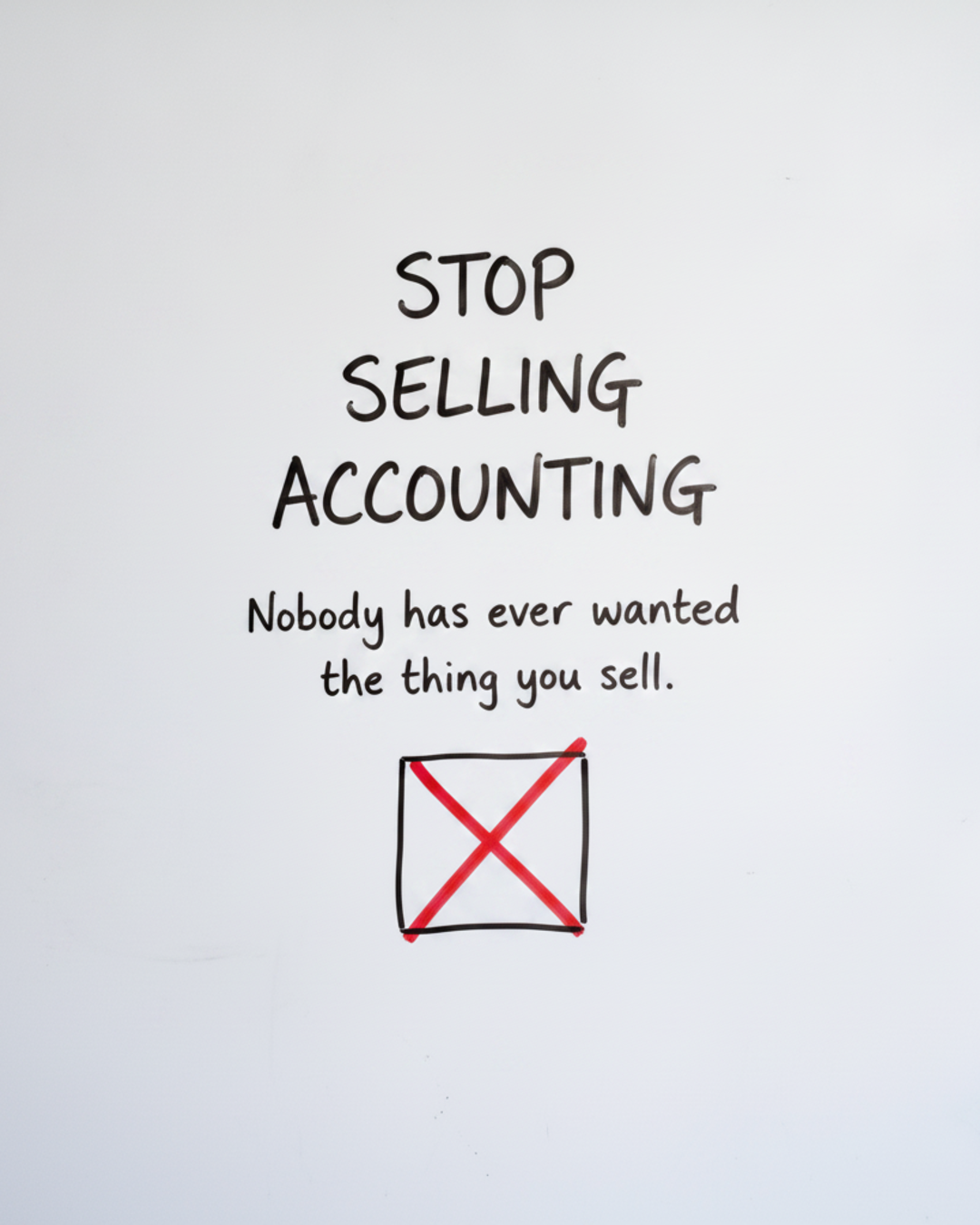
Start with an uncomfortable premise. In the entire history of your practice, not one person has genuinely wanted a corporation tax return. They wanted the obligation dealt with, the risk removed, the letter from HMRC never to arrive. The return itself is a means to that end, and means are always less interesting than ends.
This is not a criticism of the work. Compliance is skilled, necessary and often undervalued. It is a criticism of how the work gets described in public. When your marketing leads with the deliverable, you are asking a buyer to get excited about the mechanism rather than the result. They will not, because nobody ever has.
Priced like paperwork, treated like paperwork

The consequence shows up in the sales conversation before it shows up anywhere else. If a prospect understands your firm as a supplier of documents, they will price the documents. They will ring three other firms, ask what a set of accounts costs, and choose the lowest number that does not feel reckless.
Firm owners often read this as a market problem, as though buyers have simply become cheaper. In our experience it is a description problem. A buyer with no basis for comparison other than fee will compare on fee, because you have given them nothing else to weigh. The haggling is not rudeness. It is the rational response to a message that made everything look interchangeable.
Nobody has ever woken up wanting a set of statutory accounts. They wanted the worry gone. A firm that cannot name that feeling has nothing left to compete on except price.
What they are really buying

So what is the thing being bought? Usually one of a small number of feelings. Trust, meaning someone competent has looked at this and it is fine. Safety, meaning nothing is going to come back and bite. Time, meaning hours returned to a business owner who was doing the bookkeeping at eleven at night. Occasionally ambition, meaning someone who will tell them what the numbers imply about next year.
Those are the purchases. The forms are the receipt. When we run positioning work with a firm, this is the part that takes longest, because the answer has to be specific to that practice and that client base rather than a generic promise of peace of mind.
Why every firm website looks the same

Look at twenty accounting firm websites in a row and the pattern is hard to miss. A homepage, then a services grid. Tax returns. Year end accounts. Payroll. Bookkeeping. VAT. Company secretarial. Each with a paragraph explaining what it is, which the reader already knows or does not care to learn.
This happens for a sensible reason. The service list is the one part of the business that is easy to write down. It is factual, it is uncontroversial, and it requires no decision about who the firm is for. Writing it feels like progress. The trouble is that it is the same document your competitor down the road published, with a different logo on top.
Clients skip the list entirely

Here is the test we suggest to firm owners who are unconvinced. Ring three of your longest standing clients and ask them to name the filings you complete on their behalf each year. Most will manage one or two, hesitantly, and then say something along the lines of you handle all that.
That is the whole point. The list you have built your website around is invisible to the people paying for it. They are not evaluating your technical scope. They are trying to work out whether you are the sort of firm that will pick up the phone, spot a problem early and not make them feel foolish for asking. None of that appears in a services grid.
A firm that only files
An example from our own client work. One firm we support does something deliberately narrow. It submits accounts. No advisory bolt on, no forecasting product, no monthly management pack. The owner is straightforward about it, and the operation is efficient precisely because it is narrow.
On paper this looks like the hardest possible case for positioning. There is no exotic specialism to lean on, no obvious story. The owner assumed there was nothing to say beyond the fact of the service, and so that is what he said. Firms in this position often conclude they are simply in a commodity market and start competing on responsiveness and fee, which is a difficult place to build from.
He sold the filing, not the relief
Every line on his website was about submission. Accounts prepared. Deadlines met. Filed with Companies House. All true, all a description of the mechanism, and all identical to what several thousand other firms had already published.
The gap was that his actual clients were small business owners who had been doing this themselves and hating it. What they were buying was the end of an annual ordeal they were not qualified for and did not enjoy. That is a substantial thing to sell. It simply never made it onto the page, because the owner was writing from inside the workflow rather than from the client's side of the desk.
Why nobody flagged the problem

What makes this hard to catch is that nothing looked broken. The filings went in on time. Clients were content. The website was tidy, the branding was consistent, and no one who reviewed it had any specific objection.
Good delivery is very effective at hiding a message that says nothing. If the work is sound, referrals keep arriving and the practice keeps ticking over, there is no obvious moment where anyone stops and asks whether the marketing is doing any work at all. We tend to see the problem surface only when a firm tries to grow deliberately, turns on paid acquisition or invests in search, and finds the cost per client is far higher than the numbers suggested it should be.
The cost of sounding like everyone

The bill arrives quietly. When your words match the words of every other firm in the search results, a prospect comparing four options has no basis for preference. So they fall back on the only variable that visibly differs, which is the fee.
That has knock on effects beyond margin. It attracts the clients who were shopping on price in the first place, which are usually the clients who take the most administrative handling for the least revenue. It also makes every marketing channel more expensive, because paid and organic traffic both convert against the strength of the message they land on. Weak positioning does not just lose deals, it inflates the cost of every deal you do win.
Naming the thing he gives back

The fix for the filing firm was not a new service line. We worked out what the client actually receives when the work is done well, which was hours returned and a tax position that was not quietly costing them money. Then we put that at the front of the message, above the description of the mechanism.
The order matters. The service list still exists, because buyers want to confirm the scope before they enquire. It sits below the point rather than in place of it. Saying it first is what changes the arithmetic, because the first thing a visitor reads is the thing they use to decide whether to keep reading.
A different firm, a different feeling
The answer is not the same for every practice, which is why generic messaging advice tends to fail. Another firm we work with handles cross border tax. Their clients are not short of time in the way a small business owner is, and time saved is not the driver.
What those clients want is the absence of risk. They want to know that a position taken in two jurisdictions will hold up if it is ever examined. So the message leads with rigour, review and defensibility, and the tone is deliberately more conservative. Same underlying principle, entirely different expression of it. The work of positioning is finding which feeling your particular client base is buying, then being disciplined about saying only that.
Ask what they are buying

The exercise is short and most firms can run it without help. Take your last ten clients. For each one, write a single sentence describing what changed in their life or business once you took the work on. Not the deliverable, the change. Then look for the sentence that repeats.
That repeated sentence is your positioning. Everything downstream depends on it, including which niche you pursue, what your landing pages say, which search terms are worth ranking for and how your enquiry form qualifies people. Firms that skip this step end up building acquisition systems on top of a message that was never decided, and then wondering why the traffic does not convert.
Where this leaves you
None of this means the compliance work is unimportant, or that your service list should disappear. Buyers do check scope before they enquire, and technical credibility still matters. The argument is about order and emphasis. Lead with what the client receives, then evidence it with what you do.
There is also a limit to how far a message alone will take a firm. Positioning decides whether traffic converts, but something still has to generate the traffic and handle the enquiries that follow. Those parts work better when the message underneath them has been settled first.
If your firm looks like the one described here, the qualification quiz below will give you a straight answer either way on whether a structured acquisition system is the right next step, or whether the positioning work needs doing first.