
Buying marketing is easy, running the strategy behind it is not
Most accounting firms can sign an agency contract in a week. Far fewer can say who owns the plan, what the ads are aiming at, or which enquiries turned into fee income. This is for firm owners about to spend, or already spending without an answer.
Marketing strategy for accounting firms tends to fail long before the creative does. The firm decides it needs more clients, shortlists two or three agencies, picks one, and spend begins the following month. That part is straightforward. Buying advertising is a purchasing decision, and accountants are good at purchasing decisions.
What follows is harder. Someone has to decide which service the firm is actually selling, which enquiries count, and what number the whole exercise is trying to move. In most practices nobody is holding that job, so the media buyers make those calls by default, from the outside, with partial data.
We now set three conditions before any firm we work with spends a penny. This piece explains what they are, and what happens when they are missing.
Good at buying, weaker at steering
The firms we speak to are rarely bad at procurement. They can assess a proposal, negotiate a scope and hold a supplier to a deadline. That skill set gets marketing bought quickly and competently.
Steering it is a separate job. It means choosing a niche and holding the line on it, deciding which enquiries the firm wants and which it will turn down, and accepting that some of the spend is a test rather than a purchase. None of that sits naturally in a practice built around compliance deadlines and client work. So it usually falls between the partners, and a job that falls between partners is a job nobody is doing.
Spend goes out, nothing comes back in

The visible symptom is a monthly invoice paired with a report nobody can act on. Impressions, clicks, cost per lead, a chart that trends in some direction. The partner reading it has no way of telling whether the month was good.
That is not a reporting problem. It is what happens when spend leaves the business without a defined destination. If nobody agreed in advance which outcome the money was buying, no report can tell you afterwards whether you got it. Six months of this and the firm concludes that marketing does not work for accountants, when what actually happened is that the firm never told anyone what working would look like.
A firm can buy the ads in a week. Deciding what the ads are for, who owns that decision, and what counts as a win is the part nobody schedules.
The three things we settle first
So we stopped treating this as something to sort out during onboarding and made it a precondition. Three items, agreed in writing, before any budget is committed.
- One named strategy owner inside the firm who makes the calls and can be reached in a working day.
- CRM access for the people buying the media, so they can see what happened to every enquiry.
- A revenue map with an agreed target, expressed as fee income from a defined type of client, rather than more leads.
None of these cost anything. All three are refused often enough that we now ask before quoting. The rest of this piece is what the refusal looks like in practice.
The usual approach is hire and hope

The common version runs like this. The firm appoints an agency, hands over brand assets and a rough sense of the clients it likes, and waits for the first report. Strategy is assumed to be included in the fee.
Sometimes it partly is. An agency can bring positioning experience and pattern recognition from other accounts. What it cannot do is decide, on the firm's behalf, that the practice is going to stop taking sole trader self assessments and build around ecommerce bookkeeping instead. That is a business decision with staffing and pricing consequences, and no supplier should be making it. When the firm does not make it either, the campaign quietly targets everyone.
Nobody owns the plan

Ask a firm who owns the marketing plan and you often get a pause, then a name with a qualifier attached. The managing partner, in principle, when they have time. The practice manager, for anything operational. The agency, for anything technical.
Shared ownership at this level behaves like no ownership. Decisions queue. A landing page waits three weeks for sign off because two partners disagree about whether the firm wants that kind of client. Meanwhile the budget is live and spending against the last set of instructions anyone gave. The buying was easy because it required one signature. Deciding what to build requires someone with the authority to be wrong in public, and that is a different appointment.
When the brief is simply more leads
Here is the pattern in its most common form. A firm comes to us having run paid acquisition elsewhere for the better part of a year. The brief given to the previous buyers, in full, was that the practice wanted more leads.
It is an understandable brief. Leads feel like the honest unit of measurement, and partners are reluctant to commit to a revenue number they are not certain they can influence. But the word more sets no direction. More than what, from whom, worth roughly what in annual fees, and how many can the team actually onboard in a month without service slipping. Without those answers the brief is a volume request, and volume is the one thing a media buyer can always deliver.
Any single enquiry counts as success
The consequence is that every month looks like a qualified success. One enquiry arrived, so the campaign worked. Forty arrived and two were relevant, so the campaign worked. There is no standard against which a month can be judged a failure, which means there is no signal telling anyone to change course.
Any wind looks good when the boat has no bearing. The firm keeps paying, the buyers keep optimising towards cheap enquiries, and the enquiries get cheaper and less relevant in step with each other. Nobody is behaving badly. The system is doing precisely what the brief asked of it, and the brief asked for volume.
The buyers are locked out of the CRM
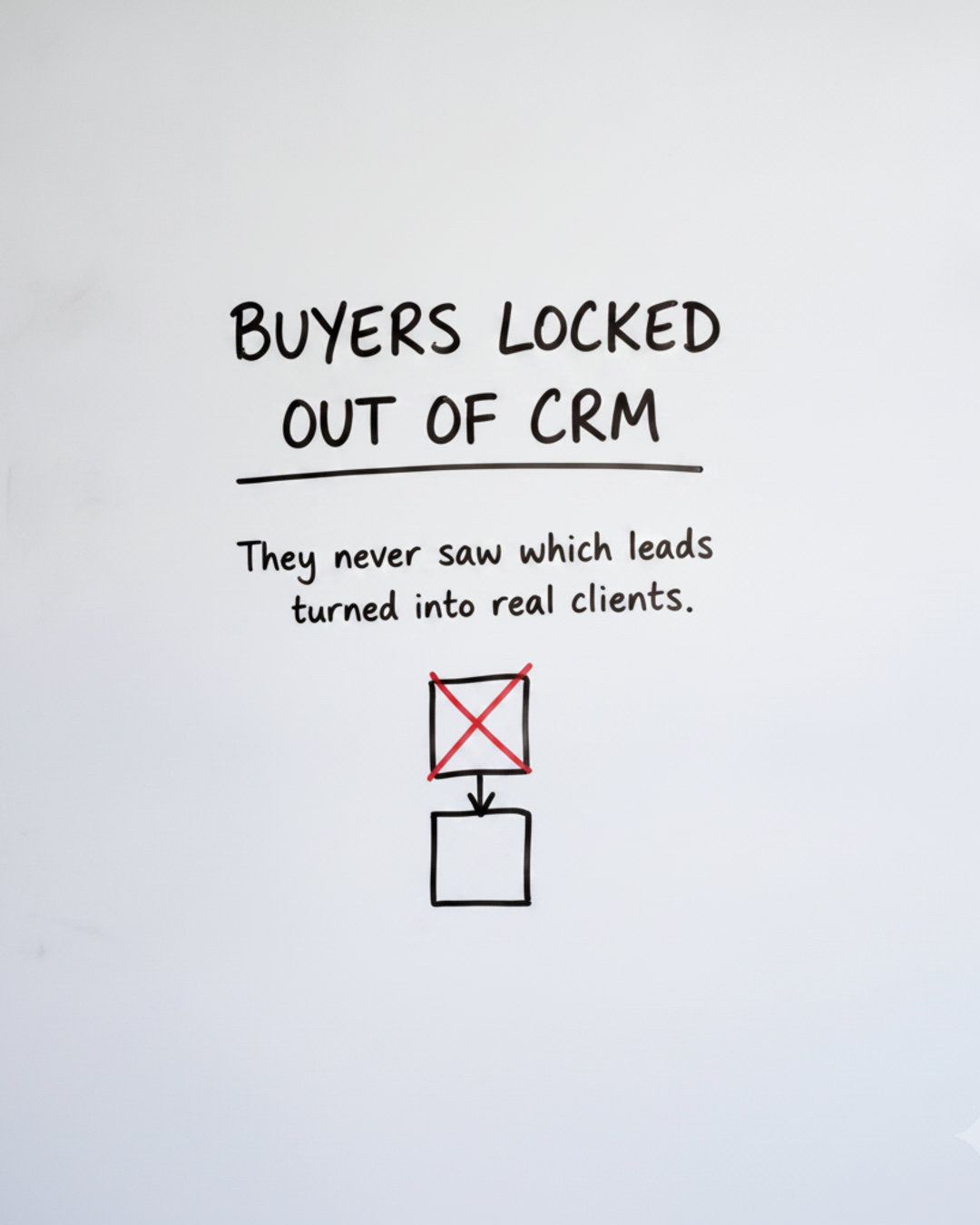
This is the part that surprises firm owners most. In the majority of underperforming setups we inherit, the people spending the budget have never seen the CRM. They know an enquiry was submitted. They do not know whether it was answered, whether a meeting happened, or whether it became a client paying a monthly fee.
Usually the reason is client confidentiality, which is a fair instinct in a practice handling financial data. It is also solvable with a restricted view showing pipeline stage and value against the enquiry source, and nothing else. Without that link, the optimisation is running on form fills, and form fills are a weak proxy for fee income.
A feedback loop measured in months
Add the missing owner to the missing data and you get the real cost, which is speed. A decision made at the start of the month runs untested until the report lands at the end of it. If that report only counts enquiries, the firm may go another two or three months before anyone notices that none of them converted.
Compare that with a firm where the buyer can see pipeline movement weekly. A campaign producing enquiries that never reach a meeting gets paused inside a fortnight. The budget is the same in both cases. The difference is how many wrong turns the firm pays for in full before correcting, and over a year that difference is substantial.
Owner, access, revenue map
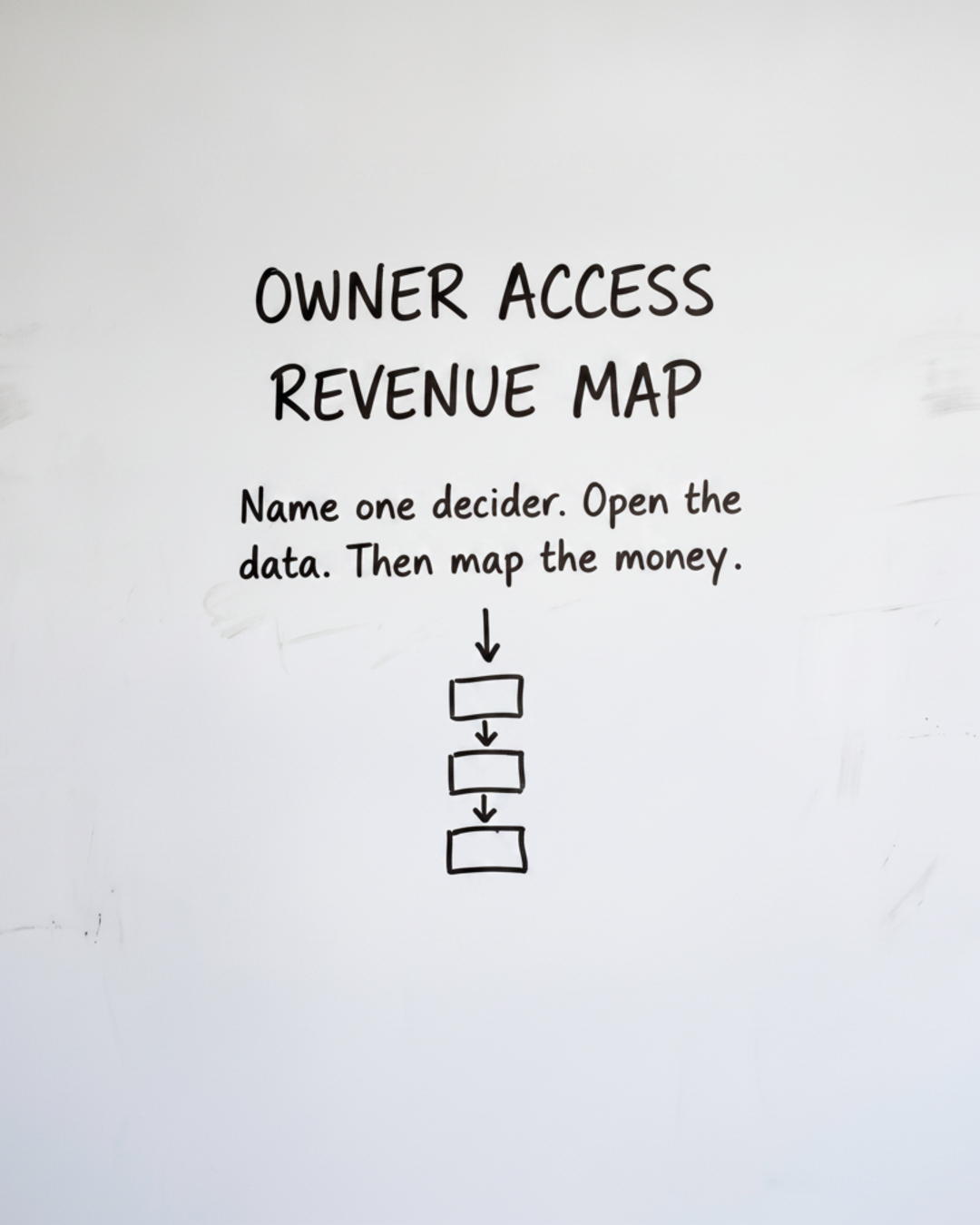
The fix is the three conditions, in order, because each one depends on the last.
Name one decider. Not a committee, one person with the authority to approve positioning, sign off pages and kill a campaign without a partners' meeting. Then open the data, giving whoever buys the media a restricted view of pipeline stage and value so the loop closes. Then map the money: work backwards from the fee income the firm wants over the next twelve months, through average client value and conversion rate, to the number of relevant enquiries that actually implies. That map is what turns marketing from an expense into a plan the firm can check its progress against.
A target the firm can miss
What the three conditions produce is a target specific enough to be missed. That sounds like a downside and it is the whole point. A number you can fall short of is a number that tells you something in month two rather than month nine.
The practical effect inside the firm is quieter than people expect. The team stops debating whether marketing is working and starts discussing which stage of the pipeline is leaking. Conversations move from opinion to arithmetic. The owner knows which clients to chase, the buyers know which enquiries to optimise towards, and everyone is looking at the same figure.
Vague goals cannot fail
A vague goal is comfortable because it can never be missed. More leads, better brand awareness, a stronger online presence. Every one of those can be reported as achieved indefinitely, which is why they survive so long in firms that are quietly getting nothing back.
Set the three rules before the first invoice rather than after the third disappointing quarter. Name the owner, open the CRM, and write the revenue map with a real figure on it. If a supplier resists any of the three, that tells you something useful about how the engagement is going to run. If your own partners resist, that tells you something useful too, and it is better to know before the spend starts.
Where to start
Marketing rarely fails in accounting firms because the ads were poorly built. It fails because the firm bought a service that needed direction and had nobody free to give it. The three conditions exist to surface that before money is committed rather than after.
There is nuance here. A firm with one partner and a clear niche can hold all three in their head and get away with it for a while. Firms with two to twenty staff and several opinions in the room generally cannot, and that is where the drift starts.
If the pattern in this piece looks like your practice, the qualification quiz below will give you a straight answer either way, including the answer that now is not the right time.