
Why price shoppers find your firm first, and better clients do not
Most accounting firms describe what they do and wait for the right person to recognise themselves in it. The people who respond to a service list are the people comparing service lists. This is what that costs, and what changes when the message leads with the result instead.
Firms rarely have a lead volume problem. They have a lead composition problem. The enquiries arrive, the diary fills, and yet almost every conversation opens with a question about fees. That pattern is not bad luck and it is not the market. It is the predictable result of attracting price shopper clients with marketing that sells the service rather than the outcome.
We work with firms of 2 to 20 staff across the UK and US, and the diagnosis is usually the same. The website, the ads and the social posts all describe the work. Bookkeeping. VAT returns. Payroll. Self assessment. Anyone who reads a list of deliverables has only one variable left to compare on, and that variable is price.
What follows is the sequence we tend to walk firms through, from the first symptom to the change that fixes it.
The price shoppers found you first

Before you blame the enquiry, look at what invited it. Somewhere on your site or in your ads there is a line that reads as an offer of a commodity, and it is still live. It has been indexed, shared and served to people for months. Every fee-led conversation you have had this quarter traces back to something written down.
This matters because marketing does not simply generate demand, it filters it. The words you publish decide which segment of the market self-selects into your calendar. If the filter is set to describe cheap, repeatable compliance work, the applicants will be people shopping for cheap, repeatable compliance work, and they will be entirely rational in doing so.
The clients you want walk past

The harder cost is invisible. The same words that pull in fee-sensitive enquiries also repel the owners you would most like to work with. A founder running a growing business with staff, stock and a funding conversation on the horizon reads a list of compliance services and correctly concludes that it does not speak to their situation. They keep scrolling.
You never see this group, which is why the problem persists. There is no report showing the good client who read two lines and left. All you see is the enquiries that did come through, so the message looks like it is working. It is working, it is just working on the wrong audience.
Nobody buys a tax return. They buy the confidence that nothing is going wrong, and the sense that someone competent is watching. Sell the result and the enquiries change shape.
Sell the result, not the service

The correction is straightforward to state and uncomfortable to implement. People do not buy accounting work. They buy the position that accounting work puts them in: a clean set of numbers when the bank asks, a tax bill with no surprises in it, a Tuesday morning where nobody is chasing receipts.
The service is how you deliver that. It is not the reason anyone chooses you. When a firm leads with the result, it gives the reader something to compare that is not a number on a quote. Two firms both offering monthly bookkeeping are interchangeable. A firm that talks about what changes in the business once the numbers are current is describing something with no obvious substitute.
Adverts written for tax returns

The common version of firm marketing is a catalogue. The homepage lists six services. The ads name a service and a location. The social posts announce a filing deadline. Everything is accurate, everything is professional, and nothing in it makes a case for one firm over another.
The logic behind the catalogue is reasonable enough. If we list everything we do, someone who needs one of those things will find us. That works, in the narrow sense. It generates matches. But a match built on a service name is a match built on availability and price, because those are the only two things the reader has been given to weigh up.
Nobody outside the profession knows what MTD means
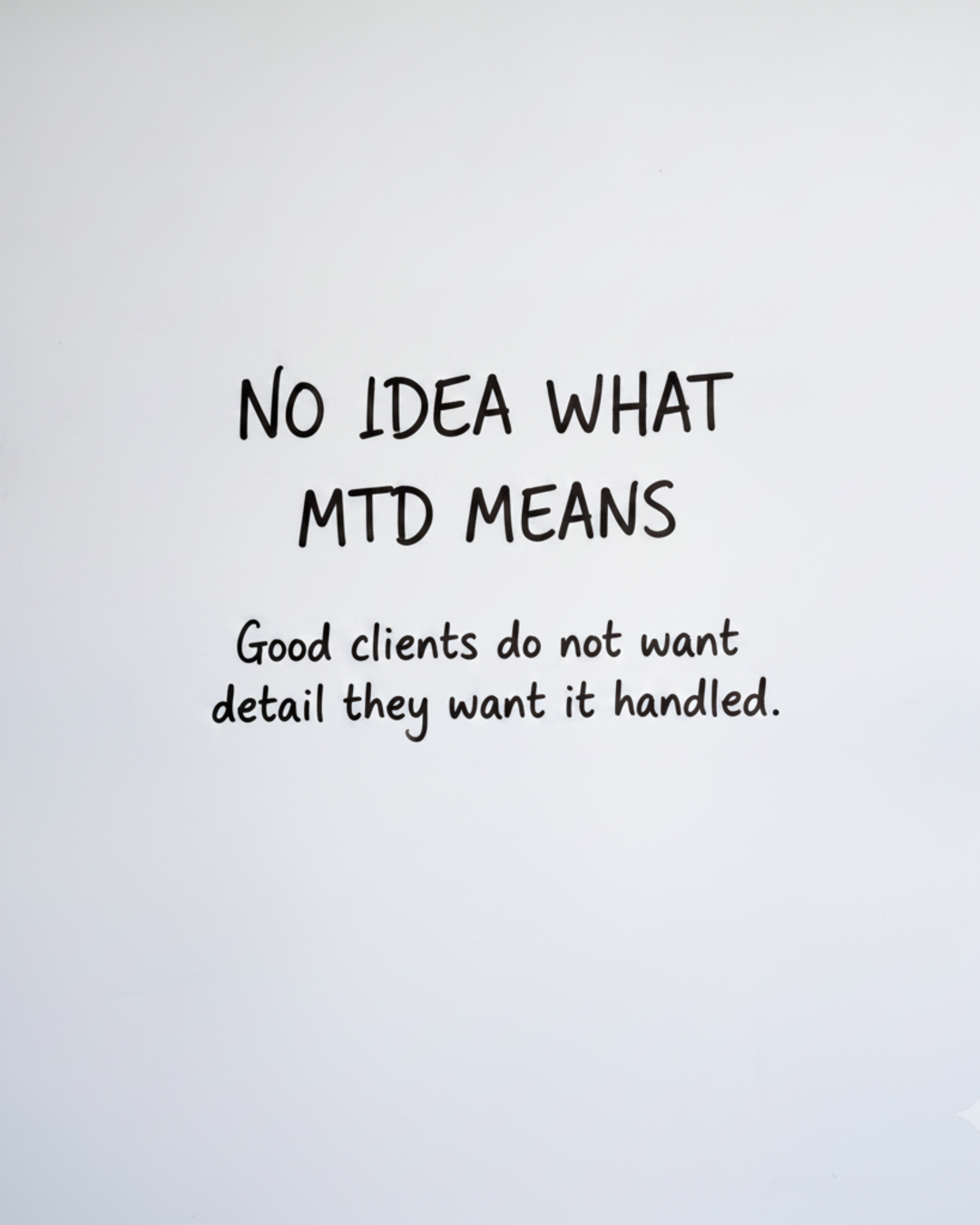
The catalogue approach also assumes a reader who understands the vocabulary. In practice the business owner you want does not know what Making Tax Digital involves, has a vague idea of what a P11D is, and has never once thought about which ledger their expenses land in. That is precisely why they are hiring someone.
Writing in technical shorthand narrows your audience to people already fluent in it, and fluent buyers are usually the ones comparing quotes across four firms. The clients with the most to gain from good advice are the ones least able to evaluate a list of technical terms. Speak to what they actually want, which is for the whole area to be handled properly and off their desk.
Get your bookkeeping sorted
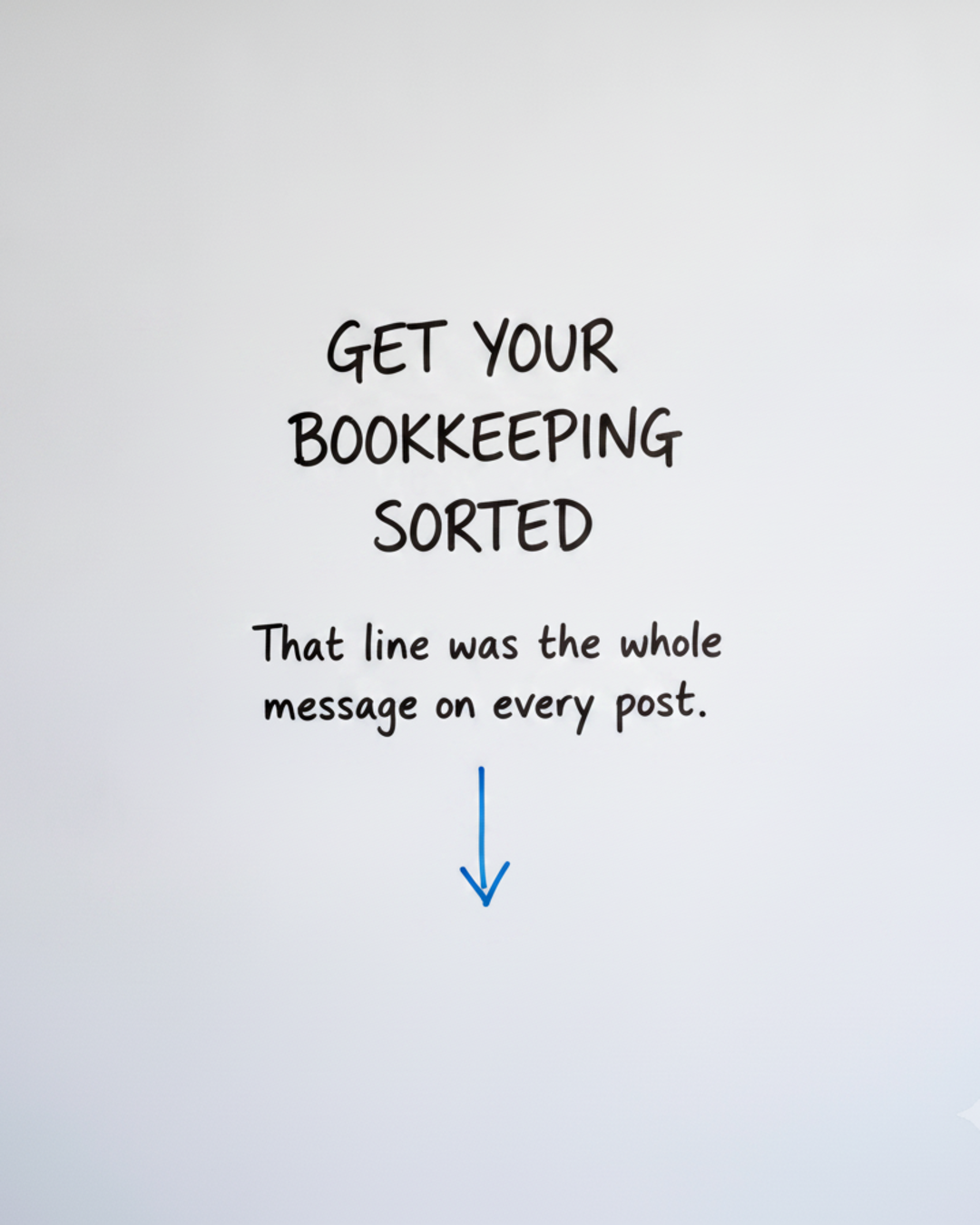
A firm we worked with had one line running across everything. Get your bookkeeping sorted. It was on the homepage, in the ad copy and in the caption of nearly every post. It is a decent line in isolation. It is clear, it is plain English and it names a real frustration.
The problem is what it implies about the buyer. Someone whose main concern is getting their bookkeeping sorted is someone who has a shoebox of receipts and a deadline. That is a legitimate job to be done, and it is also the lowest value work in the practice. The message was doing exactly what it said on the board.
Every enquiry opened with the price
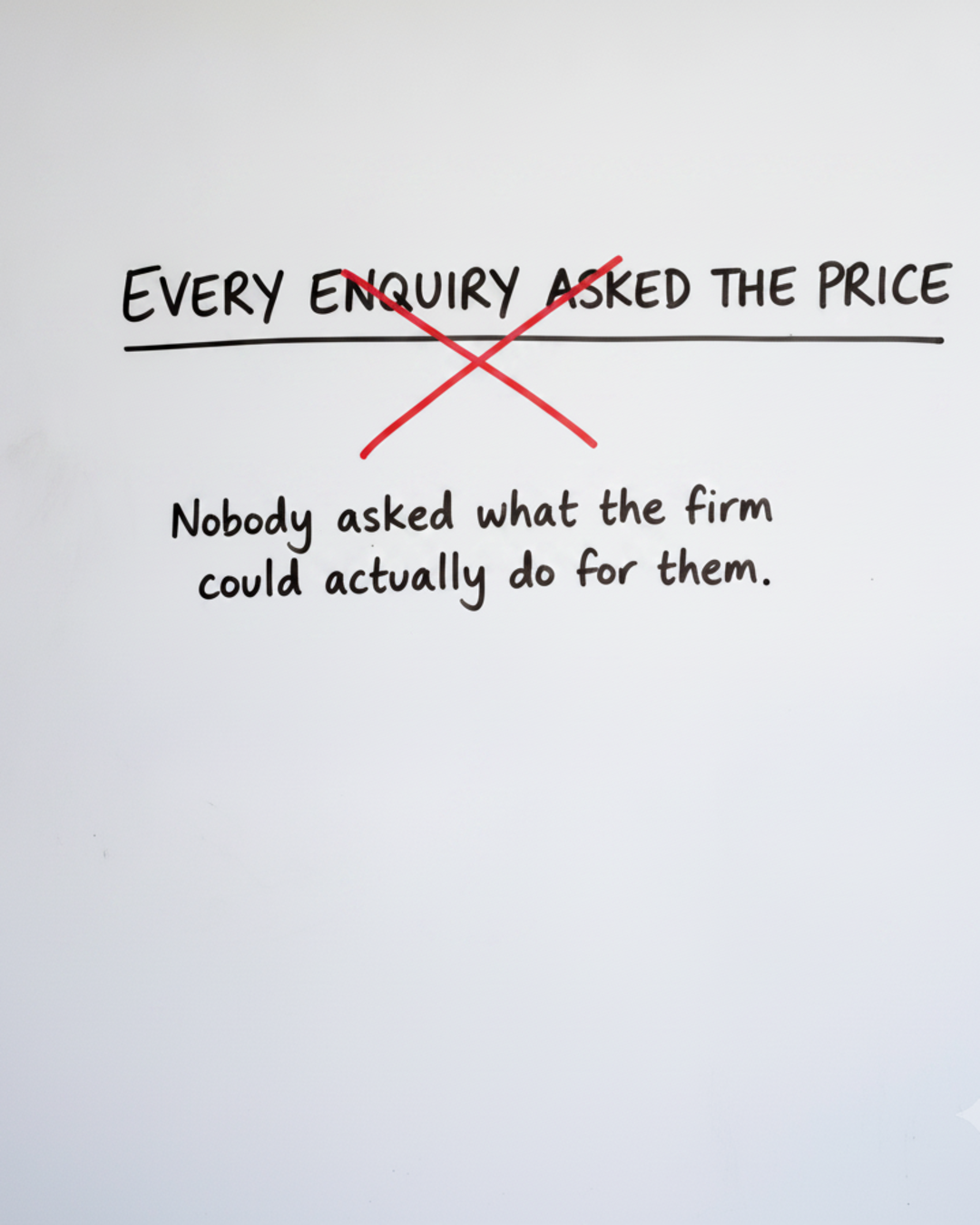
The consequence showed up in the enquiry log. Almost every conversation began with a version of the same question: how much. Not what could you do for us, not have you worked with businesses like ours, not what would you change if you took this on. Just the number.
Firms often read this as a sign that the market has become fee-driven. We read it differently. The enquiry opens with price because price is the only thing the marketing gave the reader to think about. When you hand someone a service and a name, you have handed them a procurement exercise. They will run one, competently, and you will win or lose on the fee.
The diary looked full, so nobody asked

This ran for a long time without being questioned, and the reason is the most ordinary one in practice management. The diary was full. Calls were booked, proposals were going out, some of them converted. On any dashboard the marketing looked healthy.
Volume is a comfortable metric because it moves early and it moves visibly. Composition moves slowly and only shows up in average fee, realisation rates and how much of the partner's week goes on work a junior could do. We tend to see firms review lead count monthly and review lead quality never. If nobody is asking who the marketing is attracting, the answer defaults to whoever the current message happens to suit.
More hours for the same money

The cost lands on capacity. Low fee compliance work does not sit quietly in the corner of a week. It occupies real hours, generates chasing, and arrives in a seasonal lump that consumes the exact time you would have used for advisory conversations with better clients.
So the firm gets busier without getting more profitable. Headcount goes up to service the volume, margin stays flat, and the partner ends up doing evening work on the accounts that actually matter. The trap is that the only apparent escape is more leads, which brings in more of the same work. Growth in that shape makes the underlying problem worse rather than better.
Stop leading with the work

The change we made was to reorder the message rather than rewrite the services. The work did not disappear from the site. It moved down the page, to where it belongs, as the answer to how rather than the answer to why.
What went first was evidence that the firm understood the reader's situation: the specific pressures of their sector, the decisions they were facing, what tends to go wrong and what it costs when it does. Then the outcome of getting that handled properly. Then, and only then, the mechanics of the engagement. Trust before result, result before service. That ordering is the whole intervention, and it is the same ordering we build into positioning and landing page architecture for every firm we work with.
Advisor calls instead of price calls

The volume of enquiries did not spike immediately, and we did not expect it to. What changed was the opening two minutes of every call. People arrived asking whether the firm had handled a situation like theirs, what they should be doing about a decision they were weighing up, and how quickly they could get started.
Fees still came up, because they always do, but they came up towards the end as a practical matter rather than at the start as the whole basis of the comparison. That shift is the point. When the buyer has already decided you understand their problem, the fee becomes a detail of the arrangement instead of the arrangement itself.
Client quality follows your message

The general principle is worth holding onto even if none of the specifics above match your firm. The clients you attract are a direct function of what your marketing asks people to compare. Ask them to compare services and they will compare fees. Ask them to compare understanding and outcomes and they will compare judgement.
This is not a copywriting exercise you complete once. It is a positioning decision that then has to be carried consistently through the site structure, the ad targeting, the enquiry form and the first conversation. When one part of that chain still leads with the work, it keeps letting the old audience in through a side door.
Where to start
Our position is simple. If your enquiries consistently open with a question about fees, the marketing is doing its job on the wrong audience, and no amount of extra lead volume will correct that. The fix begins with what the message asks people to compare.
There is nuance here. Some firms genuinely want high volume compliance work, and for them a service-led message is the right one. Others are mid-transition, with strong positioning on the homepage and a service catalogue still running underneath it in the ads. Both situations are worth diagnosing honestly before changing anything.
If your firm looks like the one described in this piece, the qualification quiz below will give you a straight answer either way about whether the system we build would suit how you operate.