
You can grow an accounting firm without content, if someone diagnoses the gap first
Most firm owners are told the answer is a camera, a new website or a campaign. The answer is usually a specific missing part that nobody has bothered to identify. This is for owners of small and mid sized practices who have already tried buying one fix.
There is a persistent belief in our industry that you cannot grow an accounting firm without content. Post daily, film yourself explaining the Budget, build an audience, and the enquiries will follow. It is an expensive assumption, and it is not true.
We have built a business without publishing a single video, and we have worked with firms that grew the same way. What separates the firms that grow from the firms that spend is not content volume. It is whether anyone looked at the acquisition process end to end before selling them something.
The argument below is straightforward. A firm needs traffic, a page that converts and follow up that works. Buying one of those three in isolation produces nothing, and the owner usually concludes marketing does not work.
Four years, no content

We have never posted a talking head video. No daily commentary, no personal brand, no camera. The business was built on systems that run whether or not anyone is filming, and it has grown steadily on that basis since 2024.
We mention this because the advice most firm owners receive assumes the opposite. The assumption is that visibility comes from personality, and that if you are not comfortable on camera you are structurally disadvantaged. In practice, the firms we work with do not win clients because a partner is charismatic. They win because someone searching for a specific service finds them, understands what they do, and is able to enquire without friction.
What time on camera actually costs

The reason this matters is that content is not free. A weekly video means scripting, filming, editing and scheduling, and for a partner in a practice of two to twenty staff that time comes directly out of billable or management work. Firms commit to it for three months, then look at the enquiry log and find nothing has changed.
That is the cost we see most often. Not the money, the weeks. The phone stays quiet while the calendar fills up with production tasks, and the owner starts to suspect they are simply not good enough at it. Usually the problem is that content was never the missing part in the first place.
Every part of an acquisition system depends on the part before it. Buying one piece in isolation does not give you a third of the result. It gives you nothing, and a reason to stop trying.
Three parts that sell while you work
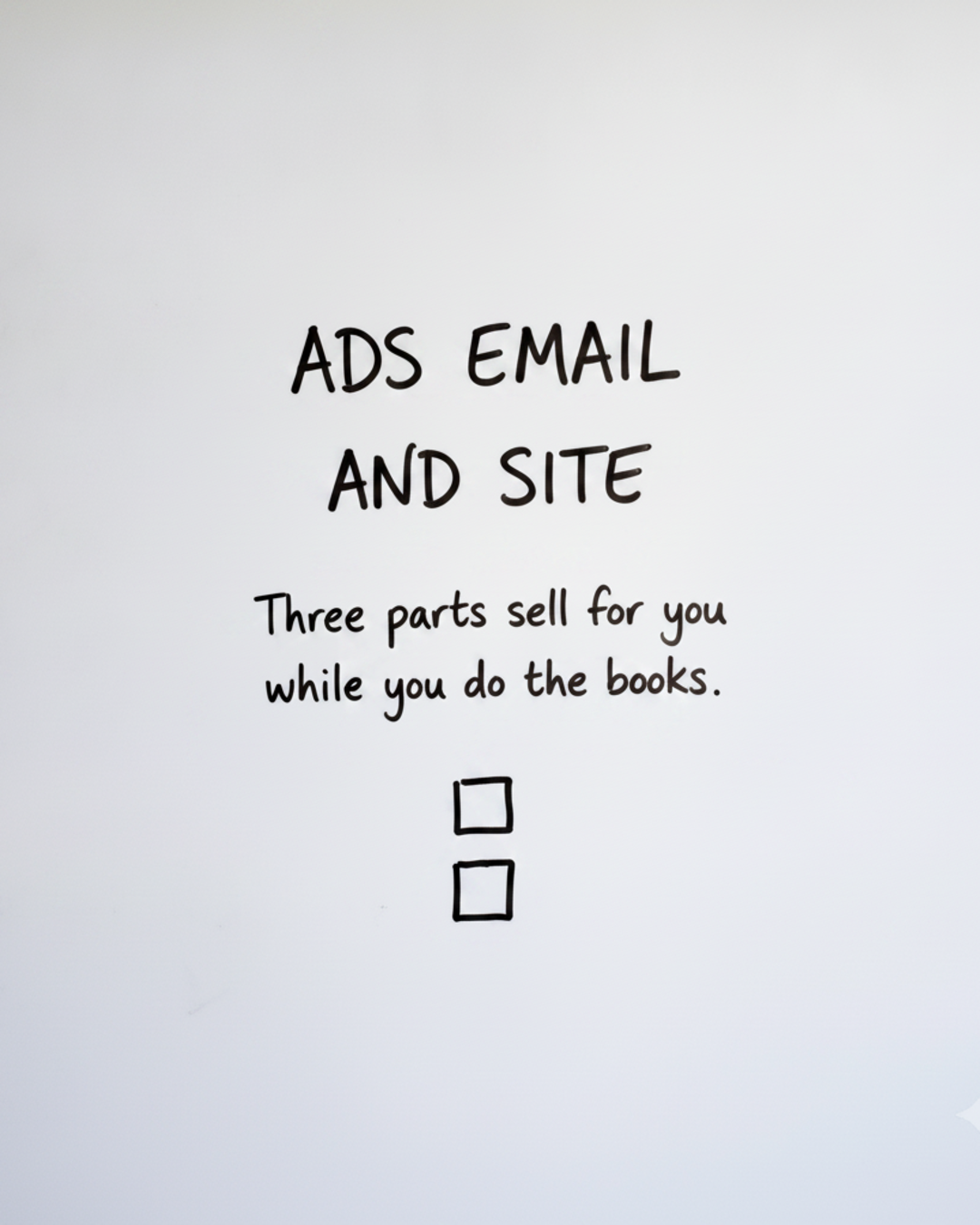
Strip acquisition back to its mechanics and there are three parts. Something that puts your firm in front of people who are already looking, which is search and paid acquisition. Something that turns that attention into an enquiry, which is the site and its landing pages. Something that handles the enquiry consistently, which is CRM and automated follow up.
Those three parts run without you. They do not need a camera, a personality or a posting schedule. They need to exist together and they need to be connected, because each one only functions if the one before it is doing its job. That is the whole model, and it is why we describe what we build as infrastructure rather than campaigns.
The single fix every agency sells

Here is where the market gets in the way. An agency that builds websites will tell you the website is the problem. An agency that runs paid media will tell you the ads are the problem. An email specialist will point at your list. Each of them is describing the part of the system they happen to sell.
None of this is dishonest. It is a natural consequence of specialisation, and the diagnosis arrives pre written before anyone has looked at your firm. The firm owner hears three confident answers to the same question and reasonably assumes at least one must be right. So they buy the one that sounds most credible and wait.
Why one part on its own does nothing
A website with no traffic is a brochure in a drawer. It can be well designed, fast, clearly written and correctly positioned, and it will still produce nothing, because conversion rate applied to zero visitors is zero.
The same logic runs in every direction. Paid traffic pointed at a page that does not explain what the firm does will burn budget. A well written nurture sequence with nobody entering it sends emails to an empty list. This is the part that gets missed when a single component is bought in isolation. You do not get a third of the outcome for a third of the system. You get nothing, and no clear evidence of why.
A firm owner who bought a site
We spoke to a firm owner who had done exactly this. He knew his online presence was weak, he was told a new website would fix it, and he paid for one. The build was competent. The pages loaded quickly, the copy was tidy, the branding was consistent.
Then he did what any partner in a busy practice does. He went back to work. Filing deadlines arrived, client queries stacked up, and the website sat there as a finished project rather than the start of anything. Nobody had told him it was one part of a system, because the brief he had been given described it as the solution.
Nobody ever visited it

Six months later the site had almost no visitors. Not a low conversion rate, almost no arrivals at all. There was no search architecture underneath it, so it did not rank for the services he sold. There was no paid acquisition pointing at it. There was no outbound activity giving anyone a reason to look.
The page existed and nothing led to it. That is a distribution failure rather than a design failure, and it is invisible unless someone actually opens the analytics and checks. He had assumed that publishing a site was the same as being found, which is a reasonable assumption for anyone who does this work once every five years.
Nobody asked what had already failed
The more useful question is why this was never caught. He had spoken to several suppliers. None of them asked what he had tried before, what his enquiry volume looked like, where his existing clients had come from, or which services carried the margin he wanted more of.
Diagnosis takes time and it does not sell anything on the call. It is far easier to quote for the thing you already build. So the firm owner is sold a fix for a problem nobody has defined, and when it fails there is no baseline to compare it against. We start every engagement the other way round, because without that picture any build is a guess dressed up as a plan.
The real cost is the conclusion
The money he spent was recoverable. The conclusion he drew was not. He decided marketing does not work for accountancy practices, that his sector is different, and that referrals are the only realistic route to growth.
That belief is expensive because it closes the question for years. It also spreads, because firm owners talk to each other and a partner who has been burned is persuasive. We meet a lot of sceptical owners, and almost all of them are sceptical for a good reason. Something they paid for did nothing. The mistake was not trying, it was buying a component without knowing which component was missing.
Diagnose before you build
The sequence we use is simple. First a conversation about the firm, the services worth selling more of, and where clients currently come from. Then a look at the actual numbers, which means search visibility, traffic, enquiry volume and what happens to an enquiry once it arrives. Only then does anything get built.
That order matters because it tells you what to build and what to leave alone. Sometimes the site is fine and the gap is distribution. Sometimes the traffic exists and the pages do not convert. Sometimes enquiries arrive and nobody follows them up within a week. Three different diagnoses, three different builds, and no way to tell them apart without looking.
Fix the gap, not the page
Once the gap is named, the work becomes narrow. In the case above the site did not need rebuilding. It needed search architecture underneath it and traffic pointed at it, so the asset he had already paid for finally had people arriving on it.
We see the same pattern in the work we do. Niall at OD Accountants had his website rebuilt around conversion rather than content, and monthly visitors went up four times over with ten to fifteen enquiries in the first month. Prads at Wings Online Filings went from five to seven enquiries a month to fifteen to sixteen through an SEO and content system. Different gaps, different fixes, same order of operations.
Look before you buy

So the practical takeaway is a question rather than a purchase. Before you commission the next website, campaign or email sequence, ask the supplier what they think is currently missing and how they worked that out. If the answer arrives before they have looked at your numbers, it is a product pitch rather than a diagnosis.
You do not need to be on camera to grow a practice. You do need to know which of the three parts is absent, because that is the only thing that tells you what to spend money on. Everything else is a guess, and guesses are what turn firm owners into sceptics.
Where this leaves you
Content can work. Some firm owners enjoy being on camera and build genuine audiences that way, and we would not talk anyone out of it. The point is that it is one option among several, and it is rarely the missing part. The missing part is usually structural, and it is identifiable in an afternoon by someone willing to look.
If your firm has already paid for one fix that produced nothing, the useful next step is diagnosis rather than another purchase. The qualification quiz below asks a short set of questions about how your practice currently acquires clients and gives you a straight answer either way, including the answer that says our system is not the right fit for you.