Why a third big client does not reduce your risk
When two clients account for more than half of your fees, the instinct is to find a third of the same size. This piece argues for the opposite move, and sets out a seven day test that tells you whether demand for one defined service actually exists. Written for owners of small and mid sized accounting firms.
Most conversations about client concentration in an accounting firm start in the same place. Two names sit at the top of the fee list, together they carry more than half the income, and the plan to fix it is to win a third account of similar size. It feels like progress because the percentages move.
We would not chase that third account. The percentages improve, the exposure does not. What changes the shape of a firm is proving that a single defined service has buyers, then building an acquisition method that adds recurring fees in smaller pieces across many more clients.
What follows is the argument for that position, the evidence we have seen from firms of this size, and a seven day test you can run next week for the price of a modest ad budget.
Another big client is not the fix
If two clients are over fifty per cent of your fees, the firm is already carrying a structural problem, and a third large account does not remove it. It reshuffles the same dependency into three names instead of two. The reason owners reach for it anyway is that a big account is a known quantity. You know where it came from, you know what it bills, and it closes in one conversation.
The alternative asks for something less comfortable, which is a test. Before any of the spending, the hiring or the repositioning, we want to know whether one specific service has buyers who will put their hand up this month.
Half your fees decided elsewhere
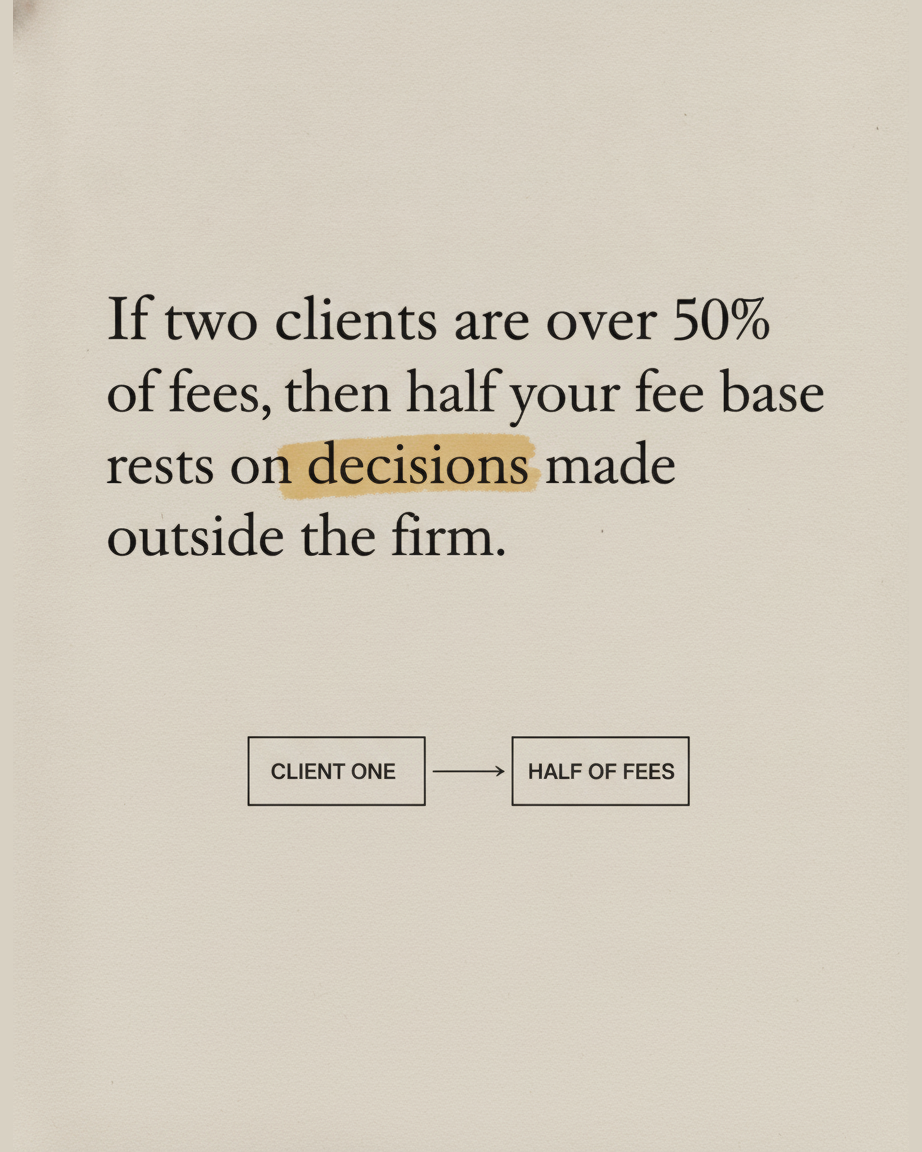
Look at what concentration actually means day to day. If two clients carry half the fee base, then half of your income depends on decisions taken in rooms you are not in. A finance director leaves. A group brings work in house. A business is sold and the acquirer already has an adviser. None of those events are about the quality of your work, and none of them give you much notice.
That is the part owners underrate. The risk is not that service slips, it is that the decision sits outside the firm entirely. Concentration converts ordinary commercial change into an event that affects payroll.
A third dominant account improves the arithmetic and leaves the exposure intact. The aim is recurring fees spread across more clients, arriving through a source you can aim, measure and repeat.
A third name changes the arithmetic only
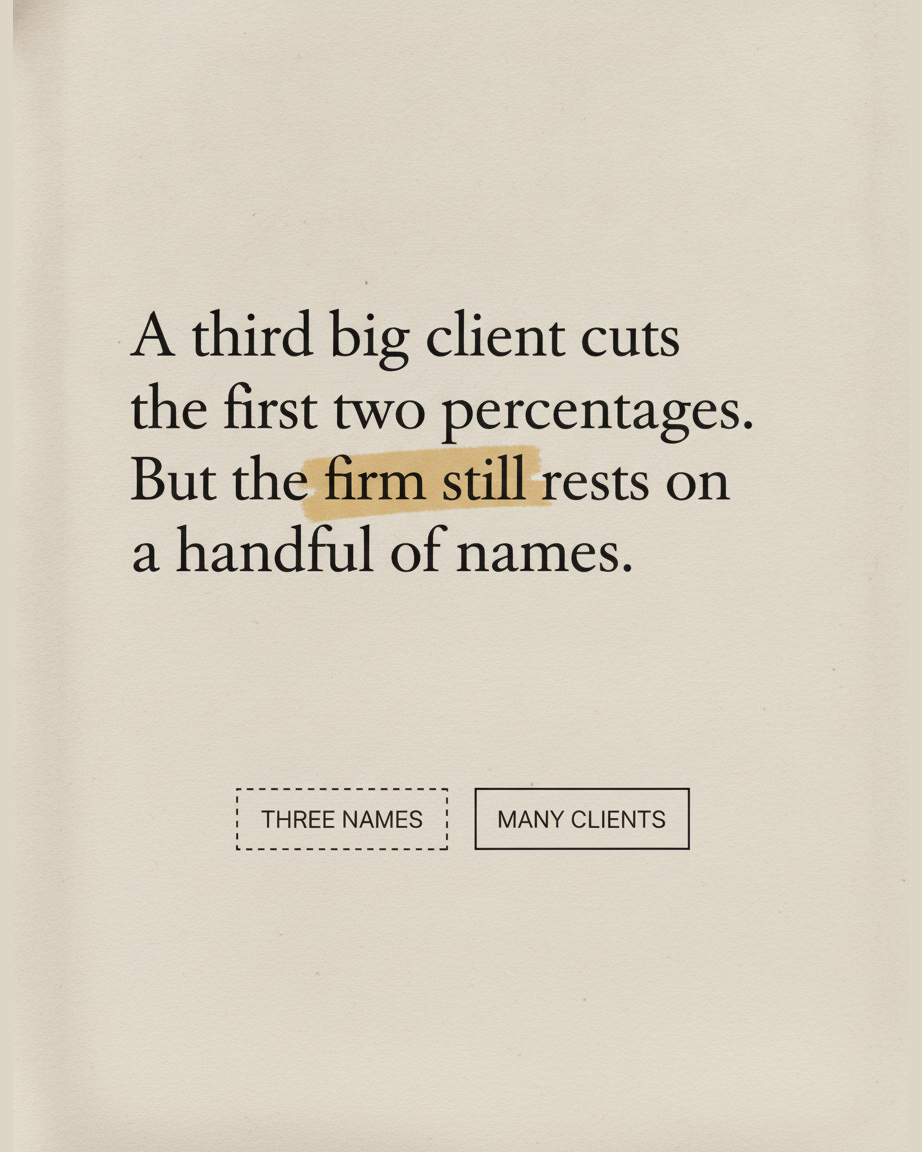
Add a third large client and the top two percentages fall. On a spreadsheet that reads as a reduced risk, and if a lender or a buyer is looking at the numbers it will pass a first glance. The firm still rests on a handful of names, and the same single decision taken elsewhere still removes a meaningful slice of income overnight.
There is a second cost that rarely gets counted. Large accounts absorb the senior time that would otherwise go into building something repeatable, so the firm becomes better at serving three clients and no better at finding the next thirty. The dependency deepens while the reported figures improve.
Recurring fees spread across more clients
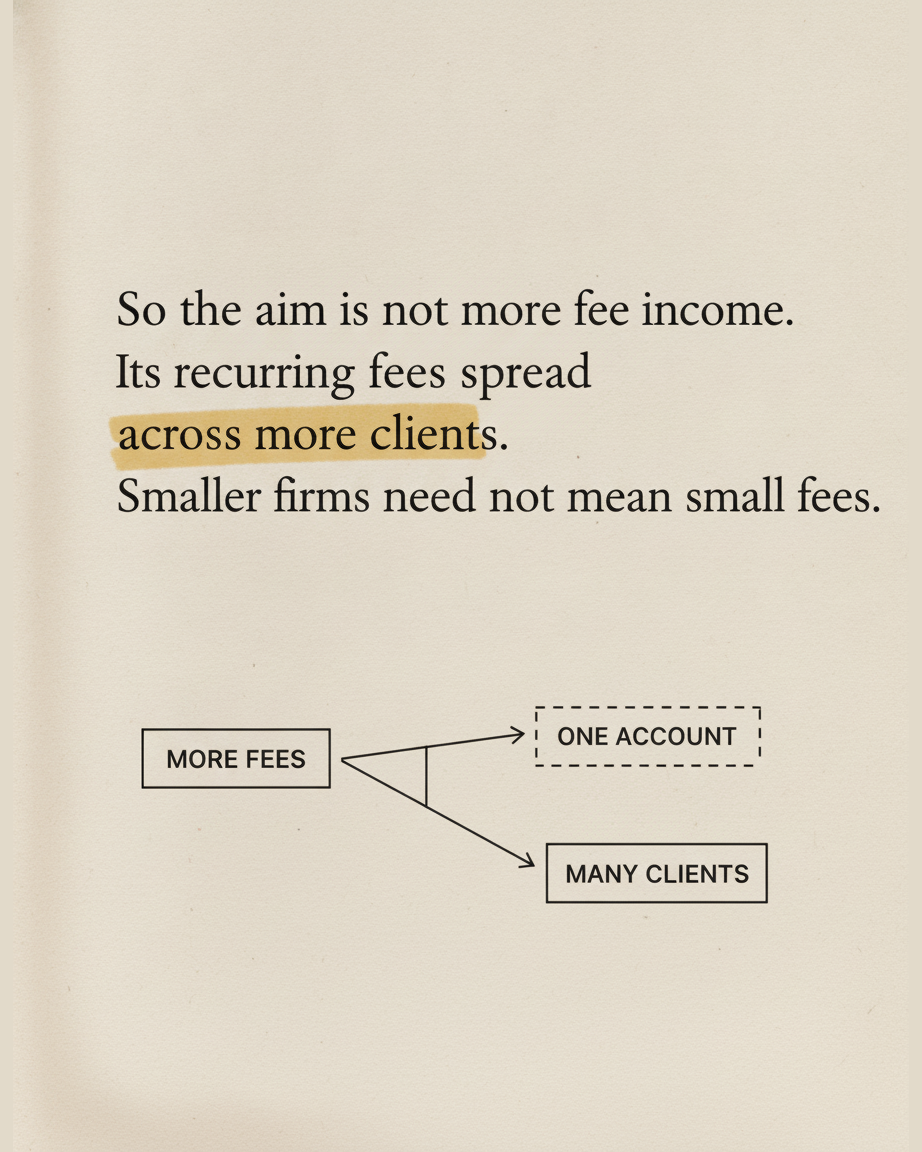
So the target is worth restating precisely. The aim is not more fee income in total, because a firm can grow its billings and become more fragile at the same time. The aim is recurring fees spread across more clients, so that losing any one of them is an inconvenience rather than a crisis.
Smaller clients do not have to mean small fees either. A limited company on a monthly compliance and advisory arrangement contributes predictable income every month, and eleven of those together can rival a single mid sized account while behaving very differently under stress. That is the trade we would take, and it is the one a seven day test is designed to open up.
A source you can aim and repeat
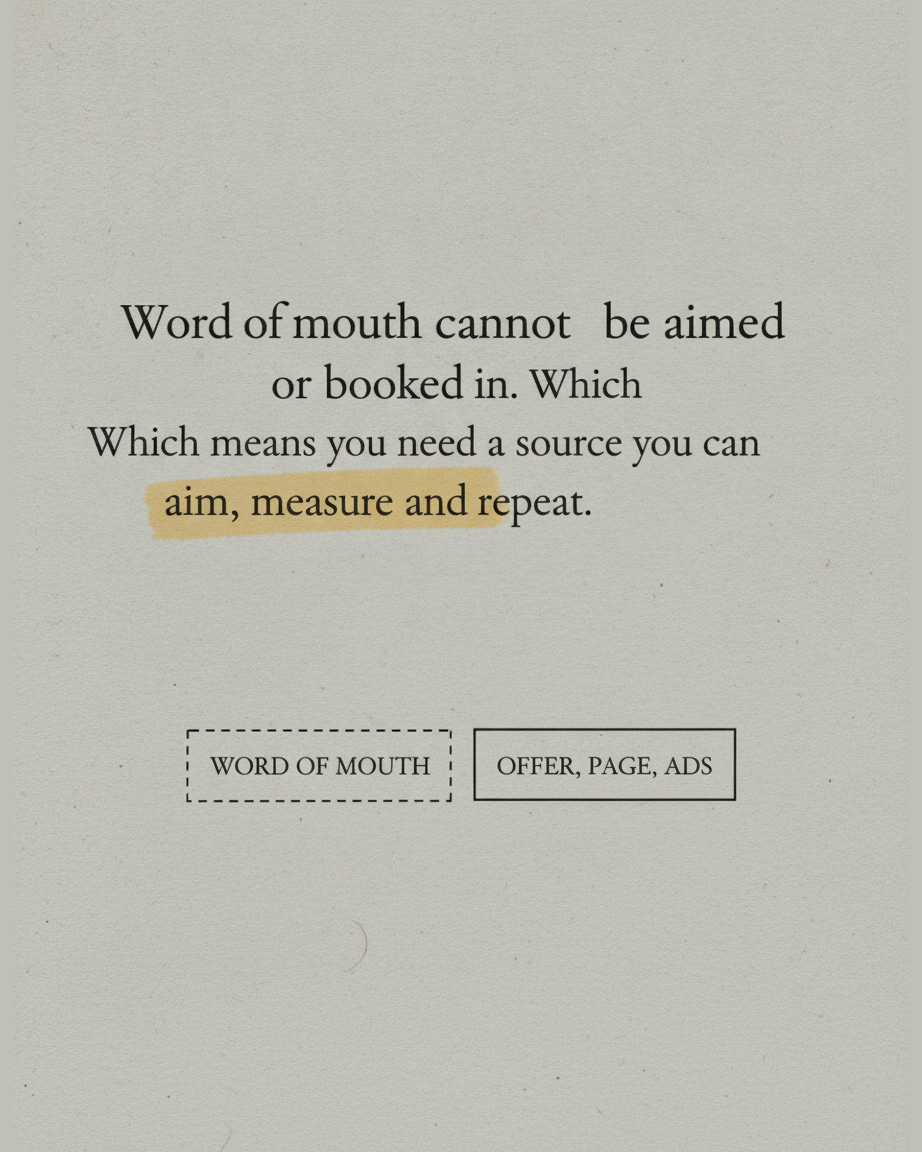
The usual objection at this point is that the firm already has a route to new clients, which is referral. Referral is genuinely good business, and we would never argue against it. The limitation is control. You cannot aim word of mouth at a particular kind of business, you cannot book it into a month, and you cannot increase it on purpose when a large account gives notice.
To move concentration inside twelve months you need a source with three properties. You can point it at a defined buyer, you can measure what it returns, and you can run it again next month. An offer, a page and paid traffic give you all three in a form small firms can actually operate.
What this looked like in Barnstaple
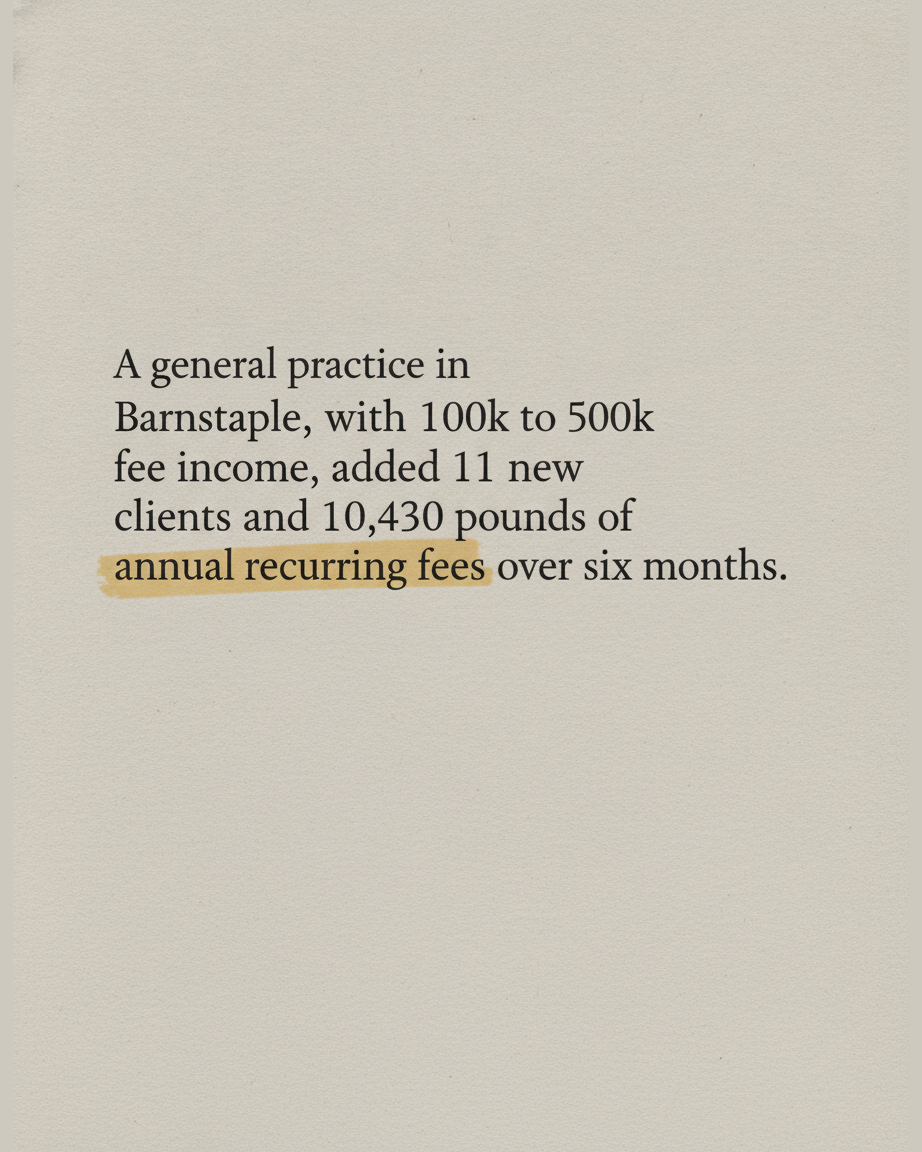
An example from a firm that fits the description. A general practice in Barnstaple, with fee income between one hundred thousand and five hundred thousand, added eleven new clients over six months and 10,430 pounds of annual recurring fees alongside them.
The number that matters there is not the headline, it is the word recurring. Eleven clients paying monthly change the shape of the fee list in a way that one project win never does. If a dominant account gave notice tomorrow, that firm is absorbing the loss from a broader base than it had at the start of the year. This is what reducing concentration looks like in practice, built in small additions rather than one replacement.
Ten pounds a day, three months
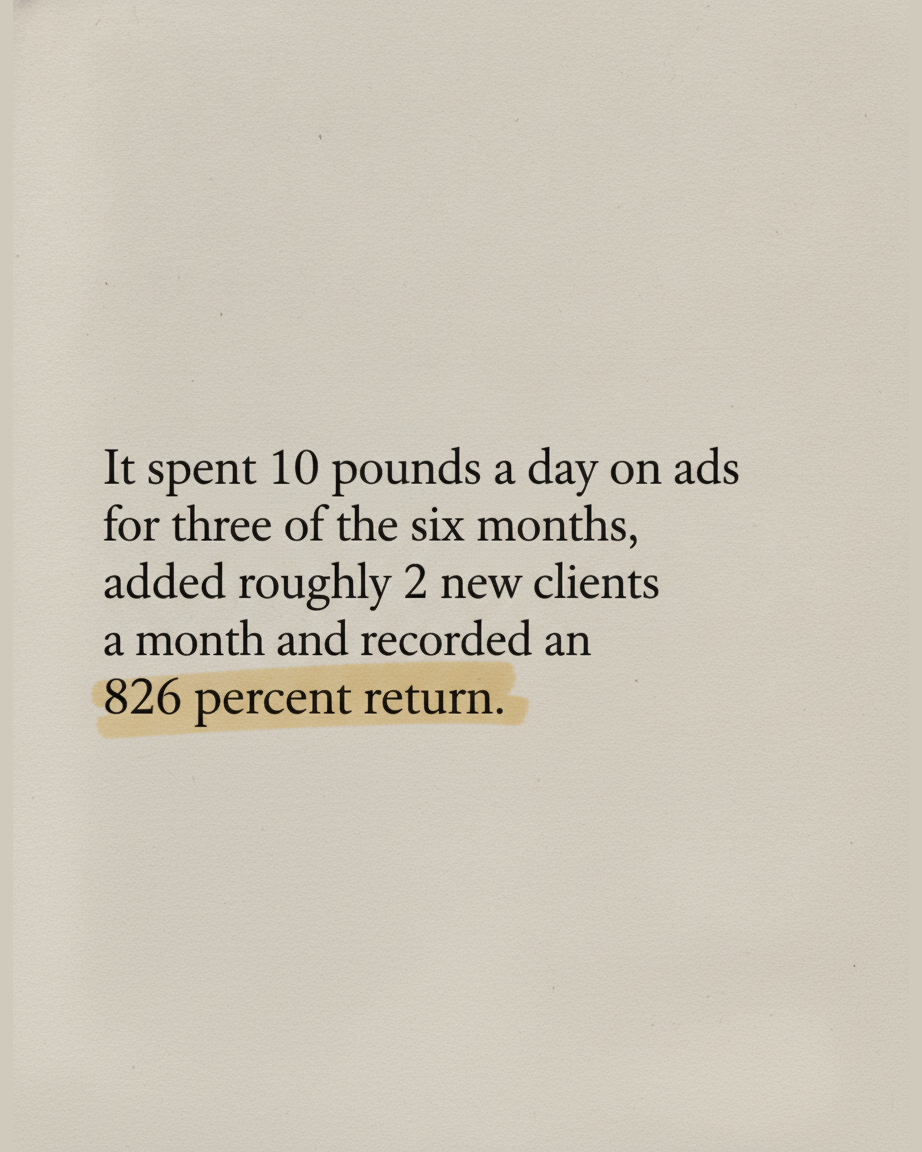
The inputs behind that result are modest, which is the point of including them. The firm spent ten pounds a day on ads for three of the six months, added roughly two new clients a month, and recorded an 826 per cent return.
We are not presenting that figure as a forecast, because returns vary with the offer, the area and the quality of the follow up. What it does show is that the budget is not the constraint for a firm of this size. A few hundred pounds over a quarter is inside the reach of almost any practice. The constraint is usually the clarity of the offer and whether anyone answers the enquiry the same day.
Thirty five leads in under a week
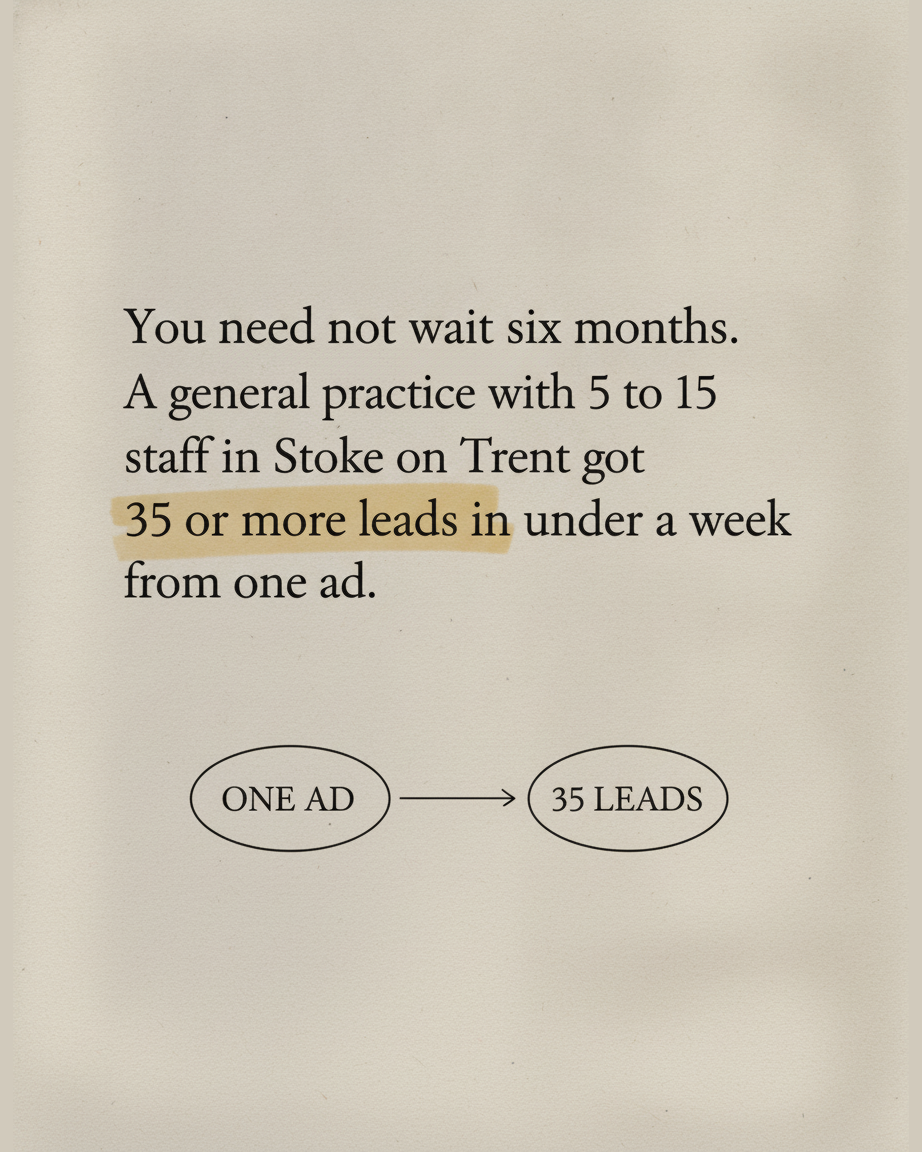
Six months is a reasonable horizon for changing a fee list. It is not the horizon for finding out whether the idea works at all. A general practice with five to fifteen staff in Stoke on Trent recorded thirty five or more leads in under a week from a single ad.
That is the useful part of the example. Within days, the firm knew that people in its area wanted the thing it was offering, phrased the way it was phrased. Everything after that is a question of capacity and conversion rather than existence of demand. Learning that quickly is what allows an owner to commit to a twelve month plan without guessing.
The wording of an offer selects the buyer

Underneath both examples sits one principle. The wording of an offer selects the buyer. A page that says the firm provides accountancy services to businesses of all sizes selects nobody, so the enquiries that arrive are whoever happened to find it. A page written for a company with a filing deadline in six weeks, or a founder incorporating this quarter, or an owner unhappy with their current adviser, selects for that person and filters out the rest.
This is why the test measures the words rather than the market. Change the phrasing and you change who responds, and often the volume of responses too. The market for accounting work in your town has not moved. The sentence describing what you sell has.
Count enquiries, not clicks
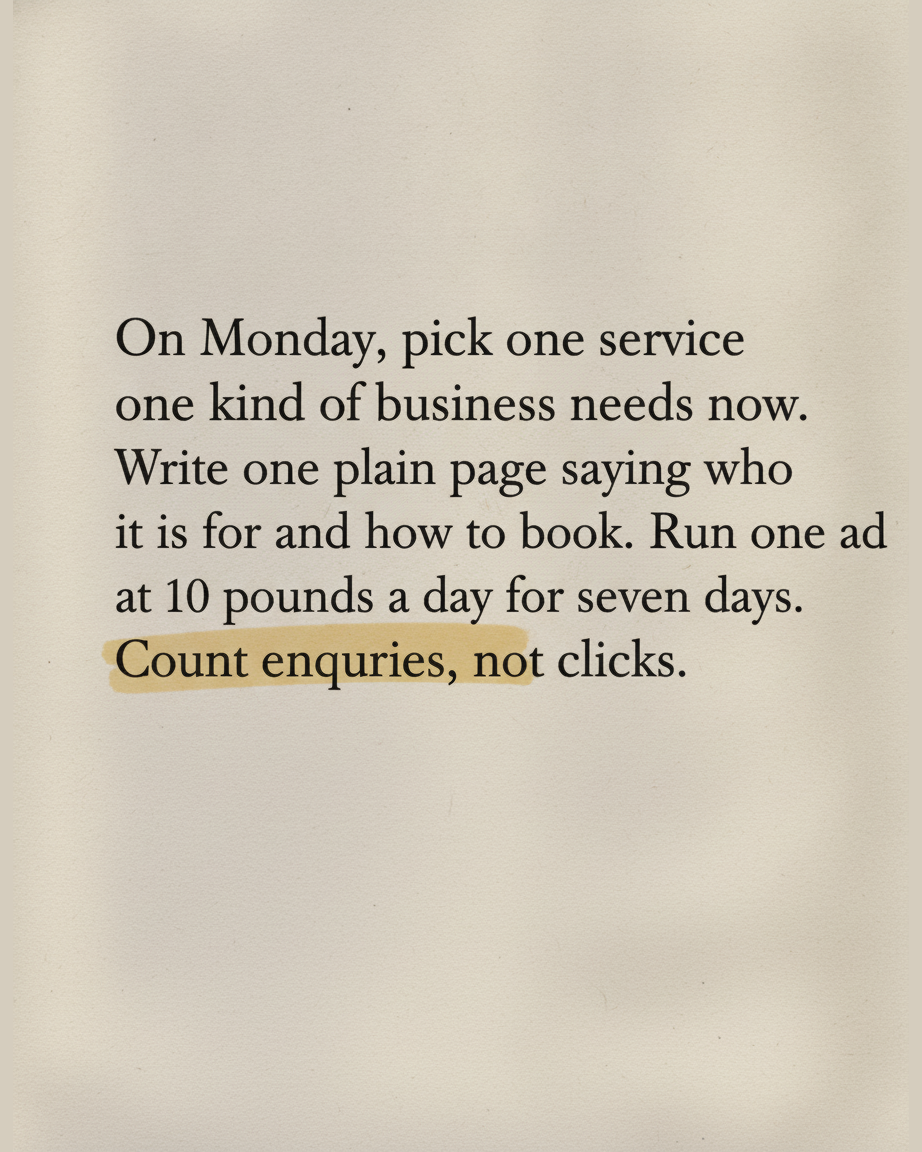
Here is the test itself. On Monday, choose one service that one specific kind of business needs now, such as a deadline they are facing, a start up registering for the first time, or a switch from another firm. Write one plain page stating who the service is for, what they can enquire about and how to book without sending an email.
Then run one ad pointing at that page at ten pounds a day for seven days, and count enquiries rather than clicks. Clicks tell you the image was interesting. Enquiries tell you someone wants the service enough to give you their name, which is the only signal worth acting on.
Five or more means demand exists
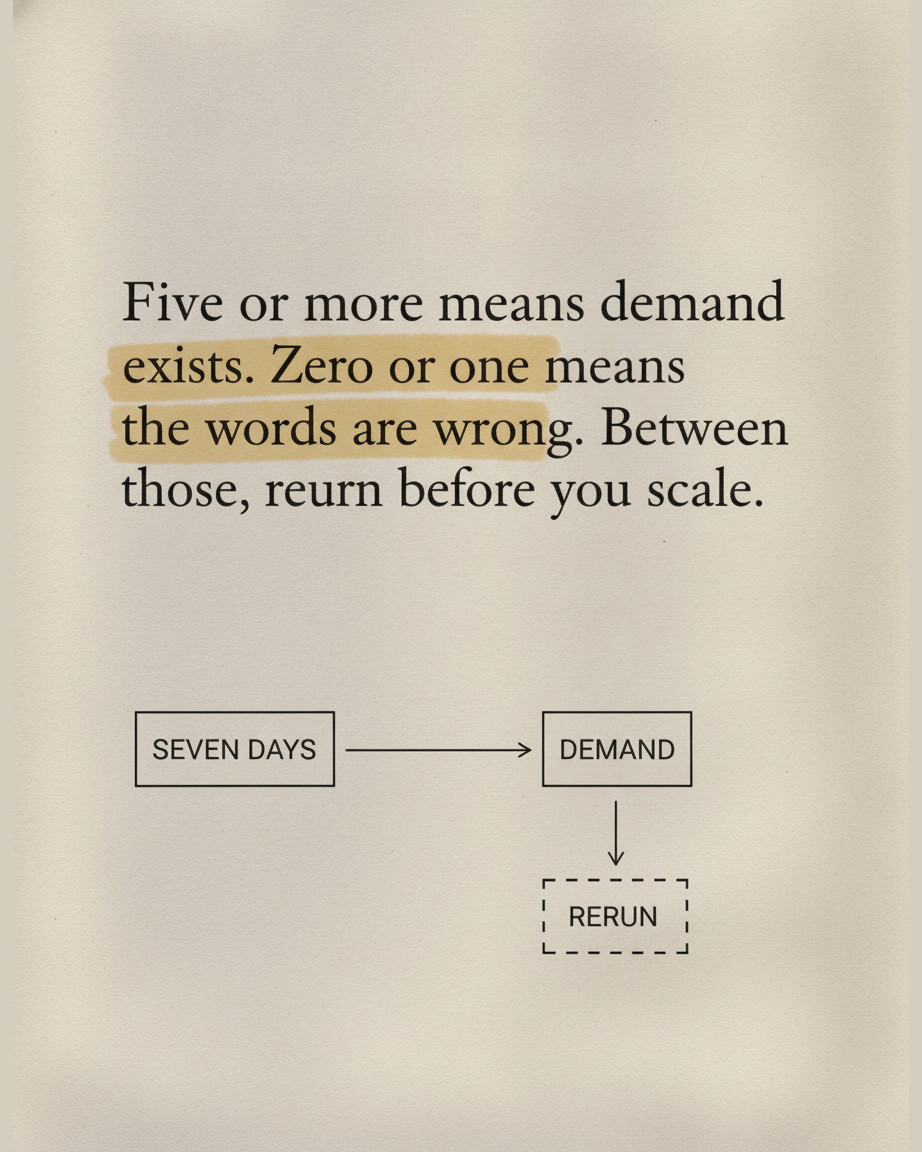
Set the thresholds before you start, because reading results after the fact invites wishful thinking. Five or more enquiries in seven days means demand exists and the firm has a visibility problem, which is the easier of the two problems to solve. Zero or one means the words or the offer are wrong, and it does not mean the market is absent.
Anything between those numbers is inconclusive. In that case change either the wording or the offer, one of them at a time, and run the week again before you scale anything. The discipline here is what keeps the exercise cheap. You are buying information for seventy pounds, then deciding what to build with it.
What twelve months of drift costs
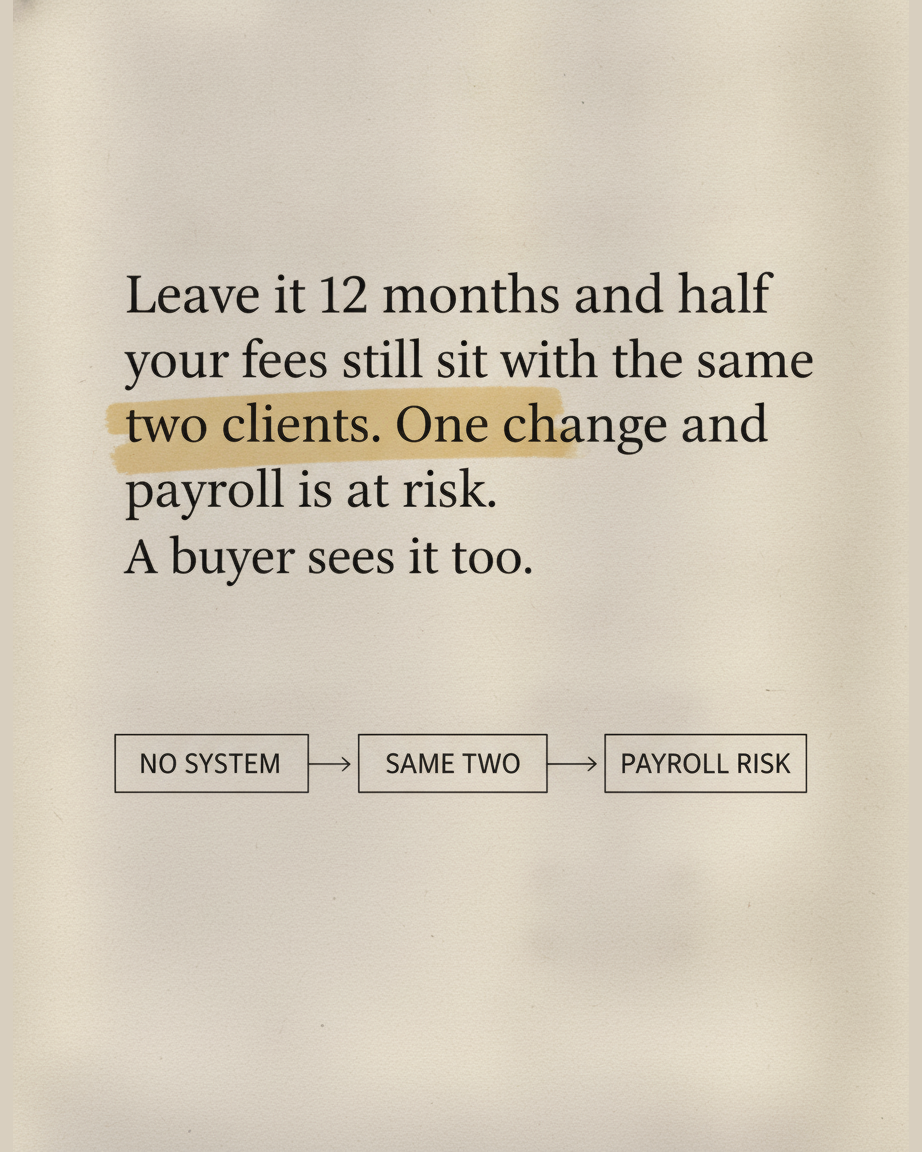
Consider the version where nothing changes. Twelve months from now, half the fees still sit with the same two clients, and the firm has spent another year getting better at serving them. One change of finance director, one acquisition, one decision to bring the work in house, and payroll becomes the immediate question.
There is a slower cost as well. Anyone valuing the practice, whether a buyer, a merger partner or a lender, reads concentration as risk and prices it accordingly. A fee list resting on two names is worth less than the same income spread across forty. Reducing concentration is retirement planning as much as it is risk management.
Where to start on Monday
Our position is straightforward. A third dominant account makes the percentages look better and leaves the firm exposed to the same kind of decision taken somewhere else. Proving demand for one defined service, then repeating the method that produced it, is what spreads recurring fees across enough clients for any single loss to be survivable.
None of this is instant. The Barnstaple example took six months, and plenty of firms need two or three rounds of wording before the enquiries arrive. What the seven day test gives you is an early, cheap answer on whether the problem is demand or visibility, which is worth knowing before you commit a year to either.
If your fee list looks like the one described here, we are happy to look at it with you and say plainly which of the two it is.