Prove direct demand before you pay for access
Joining a network buys a firm a room full of people. It does not buy a way of turning that room into enquiries. This is for practice owners weighing a four figure fee against a cheaper, faster way of finding out whether demand is there at all.
The question comes up every year, usually in January and usually from an owner who has just been invited to something. Should the firm pay four figures to join a network, or should it prove direct demand for itself first? We think the second question is the one worth answering, and it is far cheaper to answer than most owners expect.
Our position is simple. A network sells access. Access is real, and it has value, but it carries no mechanism for converting attention into enquiries. That mechanism still has to be built, and if it can be built it can be tested on its own, this week, for the price of a few lunches.
What follows is the argument, the evidence we have, the limits of that evidence, and the test itself.
One advert, thirty five leads, one week
We ran a single direct advert for one accounting service and it produced thirty five or more leads in under a week. That number is not the point on its own. The point is that it was produced without joining anything, without paying for introductions and without asking the owner to attend a single breakfast.
Most owners assume that finding new clients is slow, relational and expensive to start. Sometimes it is. But the assumption is rarely tested before money is committed elsewhere, and testing it costs very little. Before spending four figures on access, it is worth spending seven days finding out whether demand is already reachable.
A network buys a room, not a mechanism
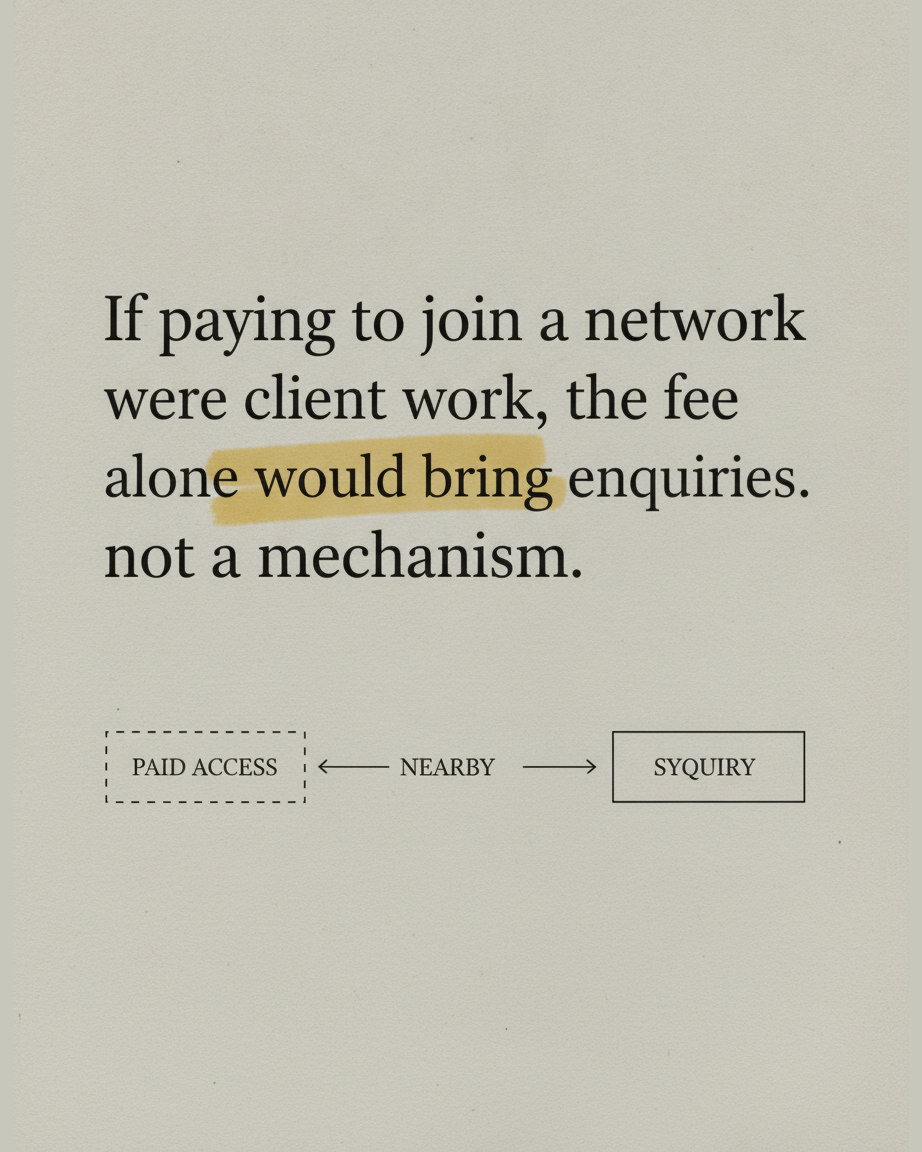
If paying to join a network were the same thing as doing client work, the fee alone would bring enquiries in. It does not, and nobody selling membership claims that it does. What the fee buys is proximity to people who might one day need an accountant.
That gap between proximity and enquiry is where the owner's time goes. Paid access puts the firm near potential work. A system takes an interested stranger and turns them into a booked conversation without anyone needing to be in the room. They are different purchases, and only one of them is repeatable when the owner is busy or away.
A network buys you a room. It does not buy you a mechanism. Seven days and a small budget will tell you more about demand than a year of opinion will.
Every introduction adds work before business
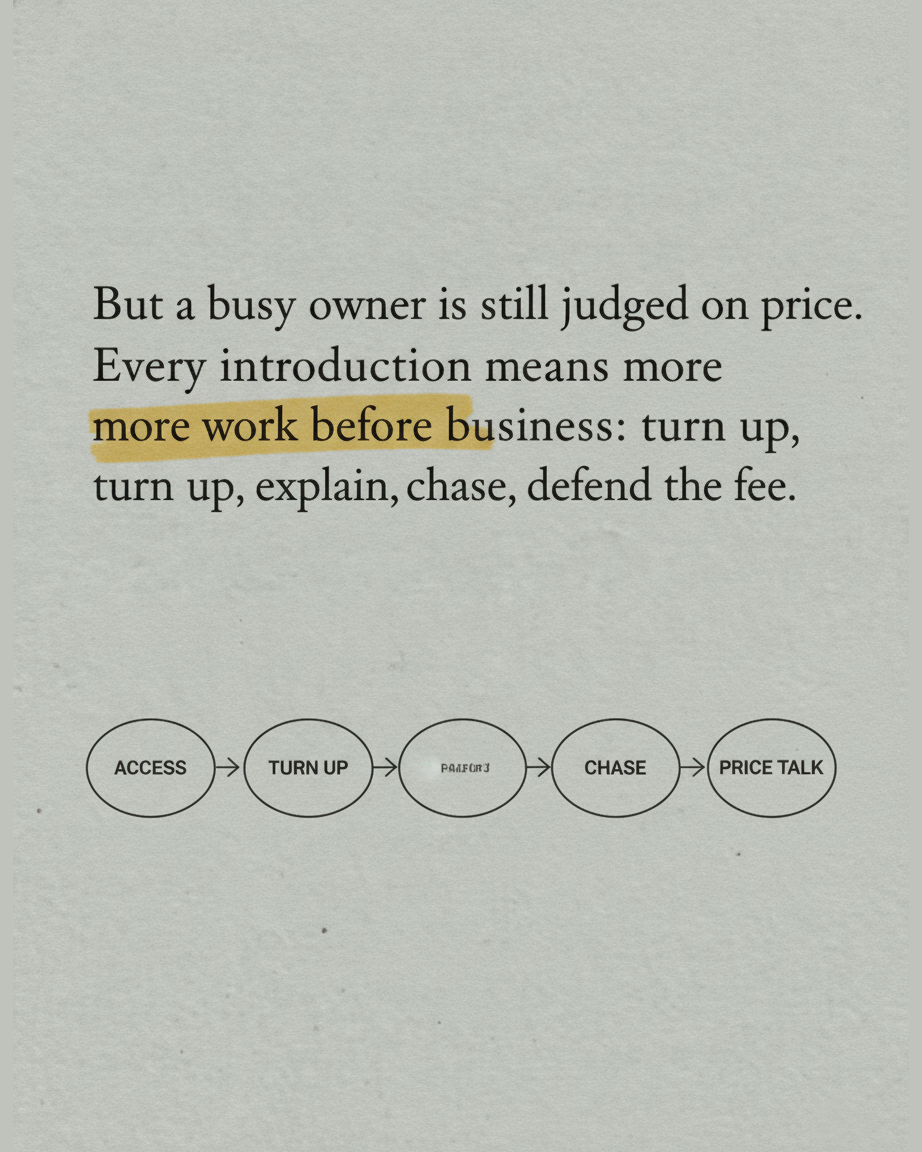
There is a second cost that rarely appears in the membership brochure. A busy owner who joins a network is still judged on price when the introduction finally arrives, because nothing in the process has established why this firm rather than the one across town.
So the sequence runs like this. Turn up. Explain the practice again. Follow up with someone who has gone quiet. Then defend the fee against a quote from a competitor who did none of the work. Each step is fine on its own. Stacked together and repeated monthly, they consume the evenings of the one person in the firm who cannot be replaced.
One page and a direct booking
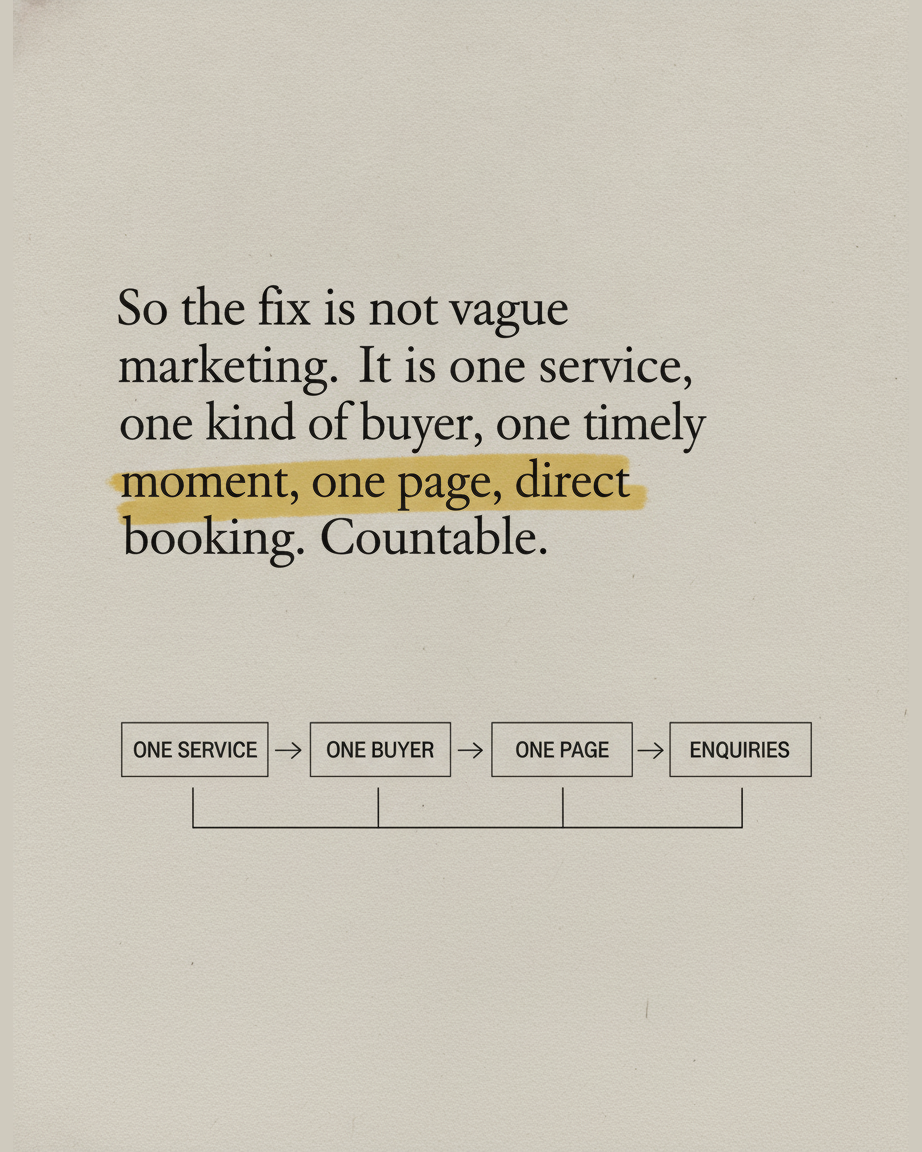
The alternative is not vague marketing, and it is not a rebrand. It is narrow on purpose. One service. One kind of buyer. One timely moment when that buyer already knows something has to be dealt with. One plain page explaining it. One direct way to book.
Narrowness is what makes the thing countable. If a firm advertises everything to everyone, a weak week tells the owner nothing, because there is no way of knowing which part failed. If a firm advertises one service to one buyer at one moment, the result is readable either way. That readability is the whole value of the exercise.
What happened at a Stoke practice
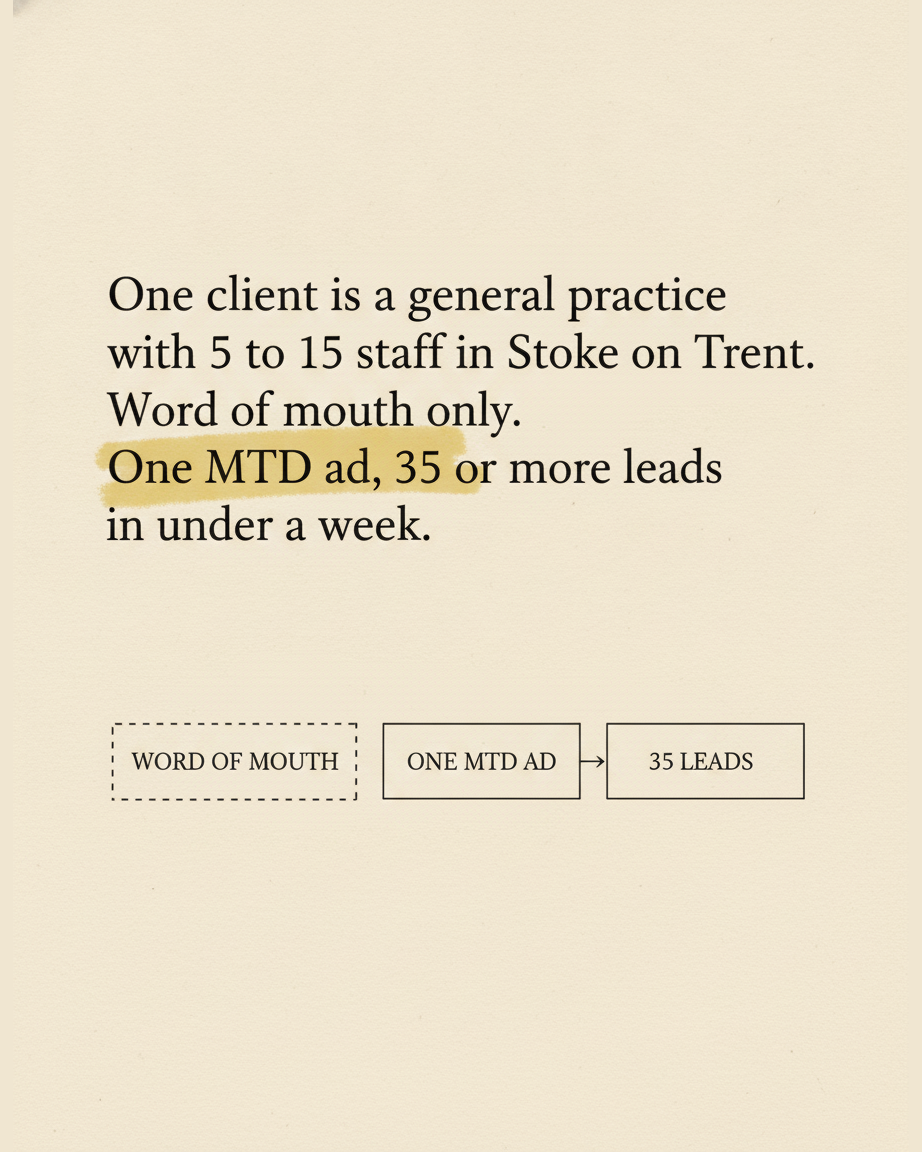
Here is where that approach was tested. The client is a general practice with five to fifteen staff in Stoke on Trent. Until then, new work arrived through word of mouth, which is a fine source of clients and a poor source of forecasts, because nobody can choose when it happens.
We built one advert around Making Tax Digital, pointed it at a single plain page and let it run. Thirty five or more leads arrived in under a week. Nothing about the firm changed in that time. The service was the same, the fees were the same and the staff were the same. Only the route in was different.
What the first month actually cost
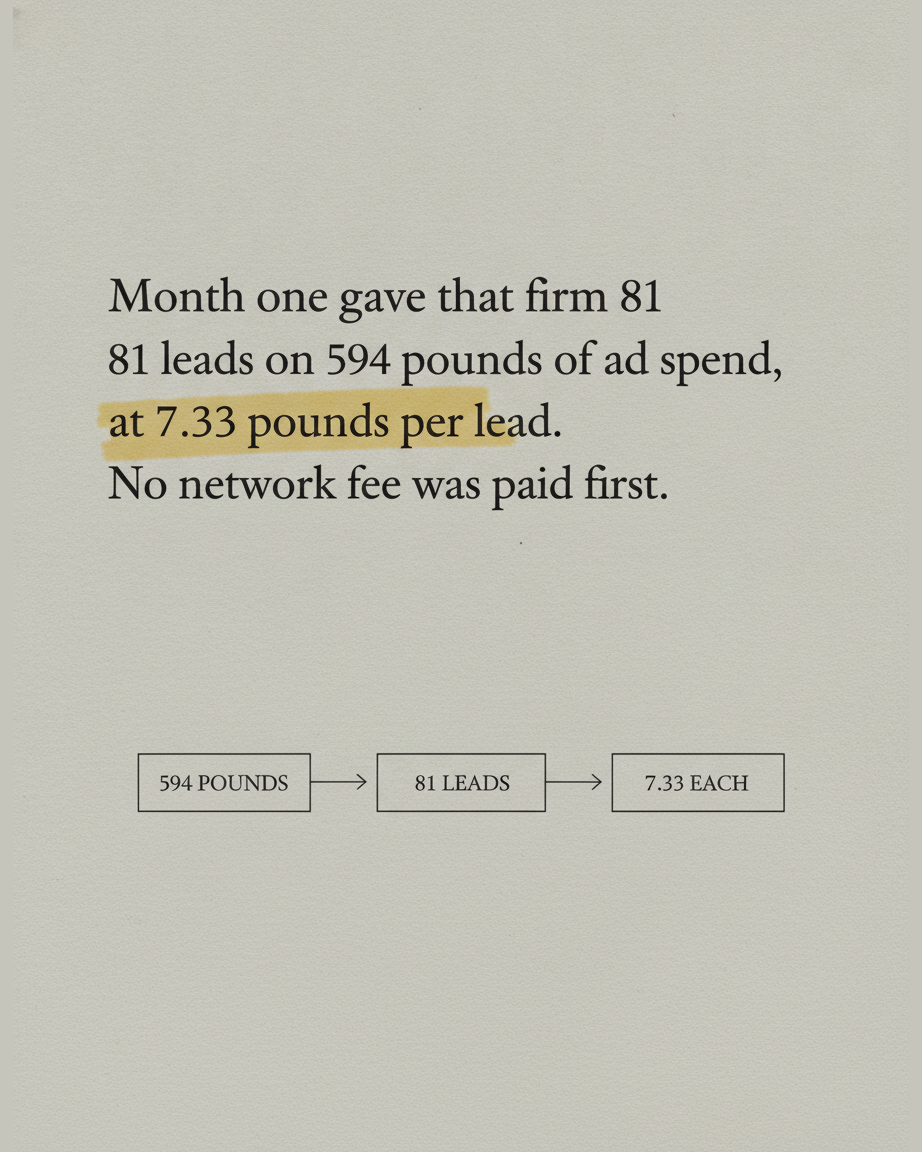
The first full month gave that firm eighty one leads from five hundred and ninety four pounds of advertising, which works out at seven pounds thirty three per lead. We include the arithmetic because the comparison matters. No network fee was paid before any of this happened.
An owner deciding between two routes is really deciding what to learn first. One route commits a large sum and delivers information slowly. The other commits a small sum and delivers information quickly, in numbers that can be checked by anyone in the office. For a profession that is comfortable with evidence, the second is the more natural starting point.
Leads are not clients, read it honestly
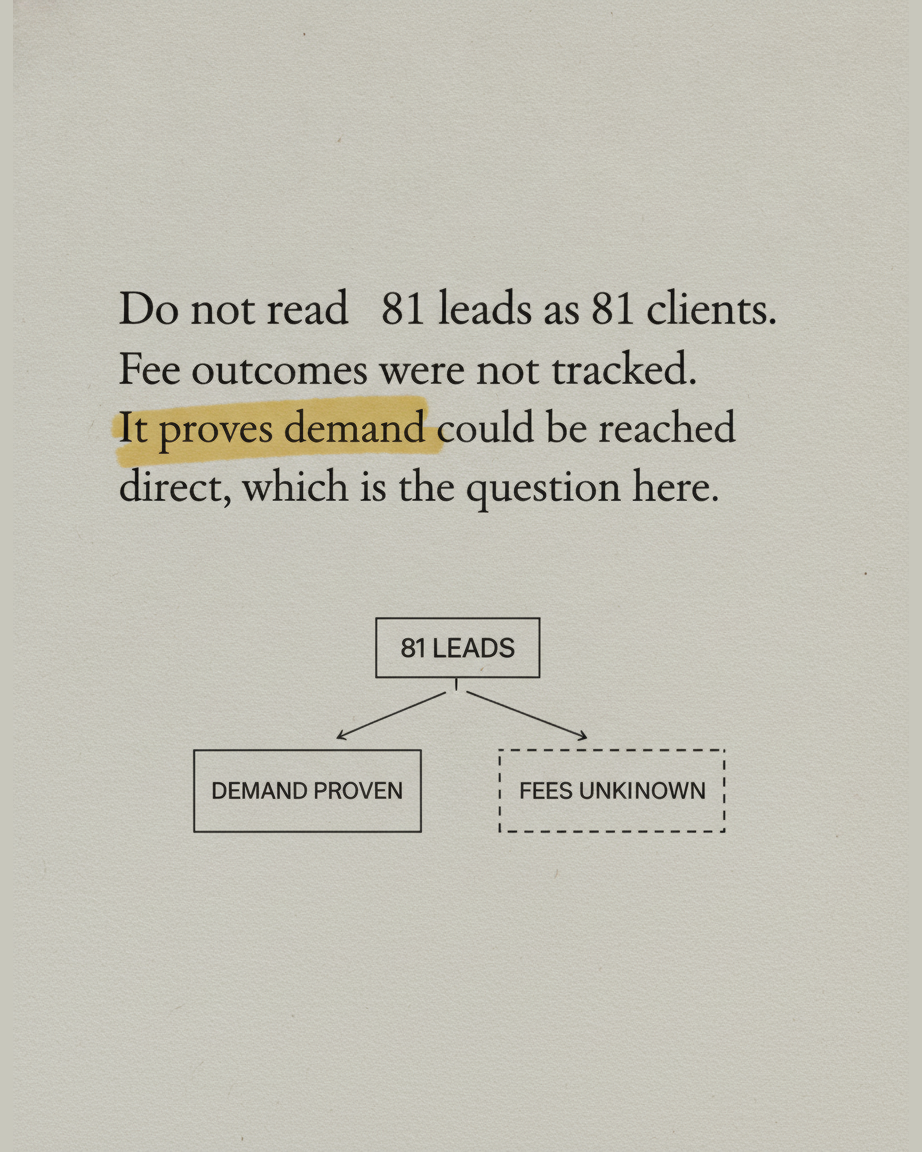
We would rather set the limits of that evidence out ourselves. Eighty one leads is not eighty one clients. Fee outcomes were not tracked on that engagement, so we cannot tell you what the work was eventually worth, and we are not going to imply otherwise.
What the result does prove is narrower and still useful. Demand for that service, in that area, could be reached directly and at a knowable cost. That is precisely the question an owner is trying to answer before committing four figures to a room. Conversion, pricing and capacity are separate problems, and they are far easier to think about once you know the demand is there.
The route that keeps growth tied to you
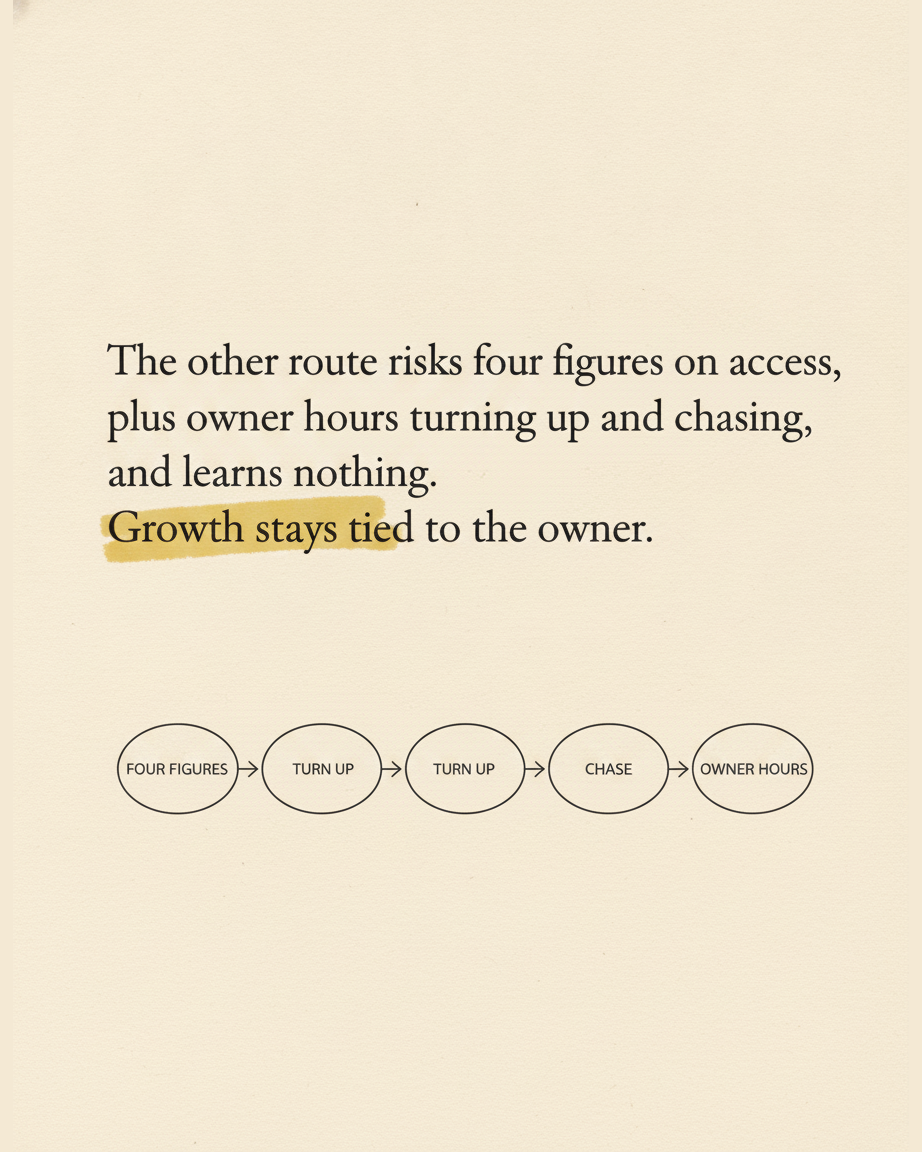
Now compare the risk on the other side. Paying to join a network puts four figures on access, then adds the owner's hours on top: the turning up, the explaining, the chasing. If the year goes badly, the firm has spent the money and learned almost nothing it can act on, because there is no clean signal in the noise.
The deeper cost is structural. Growth that depends on the owner being present cannot outgrow the owner's diary. Every new client arrives through the same narrow gate, and that gate closes whenever January arrives or somebody takes a holiday. That is a hard ceiling, and no fee removes it.
What to do on Monday morning
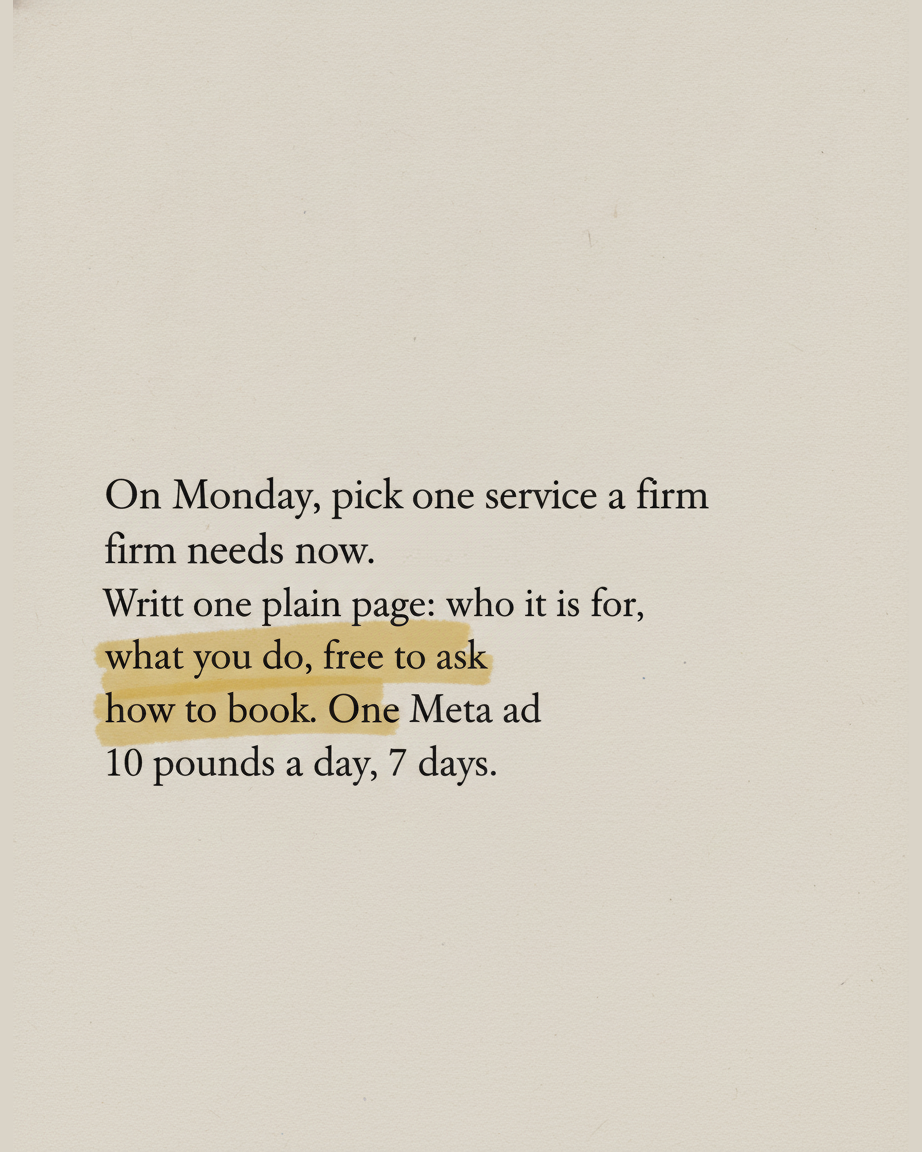
So here is the test, and it can start at the beginning of next week. On Monday, choose one service that a specific kind of business needs right now. A deadline works. So does a new company setting itself up, or a business unhappy enough to switch.
Write one plain page. State who it is for, what the service is, that it costs nothing to enquire and how to book directly. No brochure language, no history of the practice. Then run one Meta advert pointing to that page at ten pounds a day for seven days. That is the whole build. It takes a morning to write and minutes to launch.
Reading the count after seven days
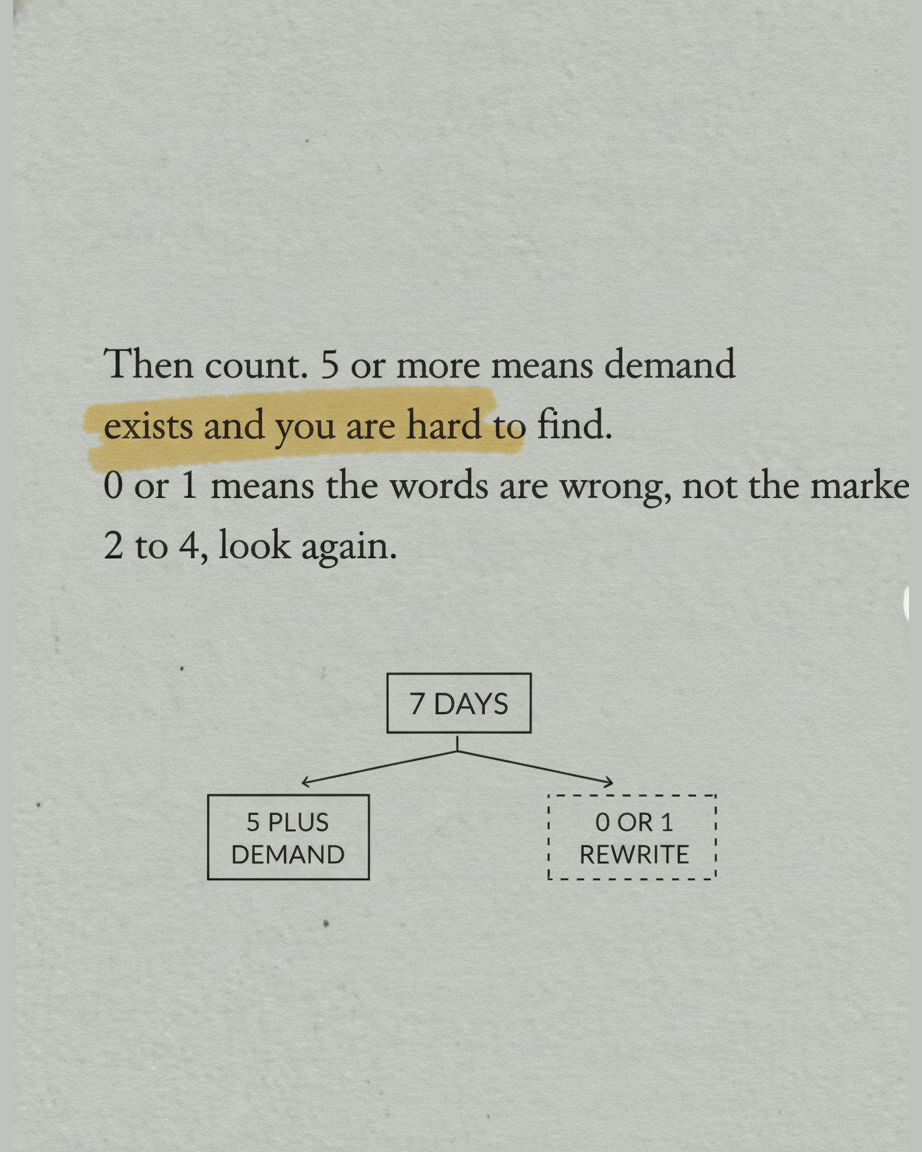
At the end of the week, count the enquiries and read the number honestly. Five or more means demand exists and the firm's real problem is being found, which is a good problem because it is fixable with more of the same.
Zero or one usually means the words or the offer are wrong rather than the market being empty. That is worth saying plainly, because most owners conclude the opposite and stop. Between two and four, treat the result as inconclusive. Go back through the page, tighten who it is addressed to, sharpen the moment it speaks to, and run a second test before drawing any conclusion at all.
Seven days beats a year of opinion
This is the principle underneath everything above. Seven days and a small budget will tell you more than a year of opinion, and accounting firms are surrounded by opinion. Peers have views on networks. Consultants have views on branding. Nobody in those conversations has run the test on your service, in your town, this month.
The test gives you a number instead of a view. It is not a complete marketing strategy, and we would not pretend it is. It is the cheapest way we know to find out whether the demand you are being asked to buy access to can simply be reached directly.
Keep this for the next invitation
Keep this to hand for the next time someone asks the practice to pay four figures for access to a room. The invitation is not dishonest and the room may well be full of useful people. The question is only whether you should buy it before you know what direct demand looks like for your own service.
Run the week first. If the enquiries arrive, you have a route that scales without the owner being present. If they do not, you have learned something for the price of a week of coffee, and you can walk into the network conversation knowing exactly what you are buying and why.
Where we would start
Our position has not moved. Prove direct demand first, with one timely service, one plain page and one seven day advert, and decide about access afterwards with a number in hand. Networks are not the villain here. They sell a room, they say so, and for some firms the room is worth it. The mistake is buying it before knowing whether the demand was reachable without it.
There is nuance we would not skip. Seven days is a signal rather than a verdict, and a middling result usually means the words need work rather than the market being absent. If your firm looks like the one described here, and you would rather talk the test through before running it, we are happy to do that.