Your wording filters the market before anyone books a call
Most firms read poor enquiries as a pricing problem and start discounting. In our experience the wording of the offer has already decided who bothered to reply. This is for practice owners who are getting leads and winning nobody.
A partner tells us the enquiries are terrible. Sole traders with a shoebox of receipts, people who want a number over the phone, businesses that were never going to be a fit. The conclusion arrives quickly: the fee must be too high for this market.
We think that conclusion is reached too early. The relationship between ad wording and lead quality for accountants is far stronger than most firms assume, and it operates before a sales call ever happens. The words on the ad describe a buyer, and that buyer is the one who self selects into your inbox.
So there is a cheaper test to run first. Hold the spend, the audience and the landing page still, change only the sentences, and watch what kind of person turns up.
Same budget, new words, different replies
We have watched this happen enough times to trust it. The daily spend stayed where it was. The audience settings were untouched. The landing page was the same page it had been for months. The only thing that changed was the sentences in the ad, and the people who replied were different people.
That is an uncomfortable result if you have already decided the market cannot afford you. It is a useful one if you would rather find out before you drop your fee and spend a year rebuilding it. Run this test first, because it is the cheapest piece of evidence available to you.
If the channel were the problem
Follow the usual explanation to its end. If the poor enquiries were caused by the channel, or by the size of the budget, or by the audience you selected, then the wording of the ad would be close to irrelevant. You could rewrite the whole thing and the same people would reply in the same numbers, because the cause would sit elsewhere.
That is a testable claim, and it fails almost every time we test it. Wording changes outcomes, which tells us the words are doing some of the filtering. Once you accept that, the diagnosis of a poor month has to include the sentences you wrote.
The wording of an offer selects the buyer. Change the sentences and you change who replies, which means poor enquiries are evidence about your marketing long before they are evidence about your fee.
Hold everything still, change the words
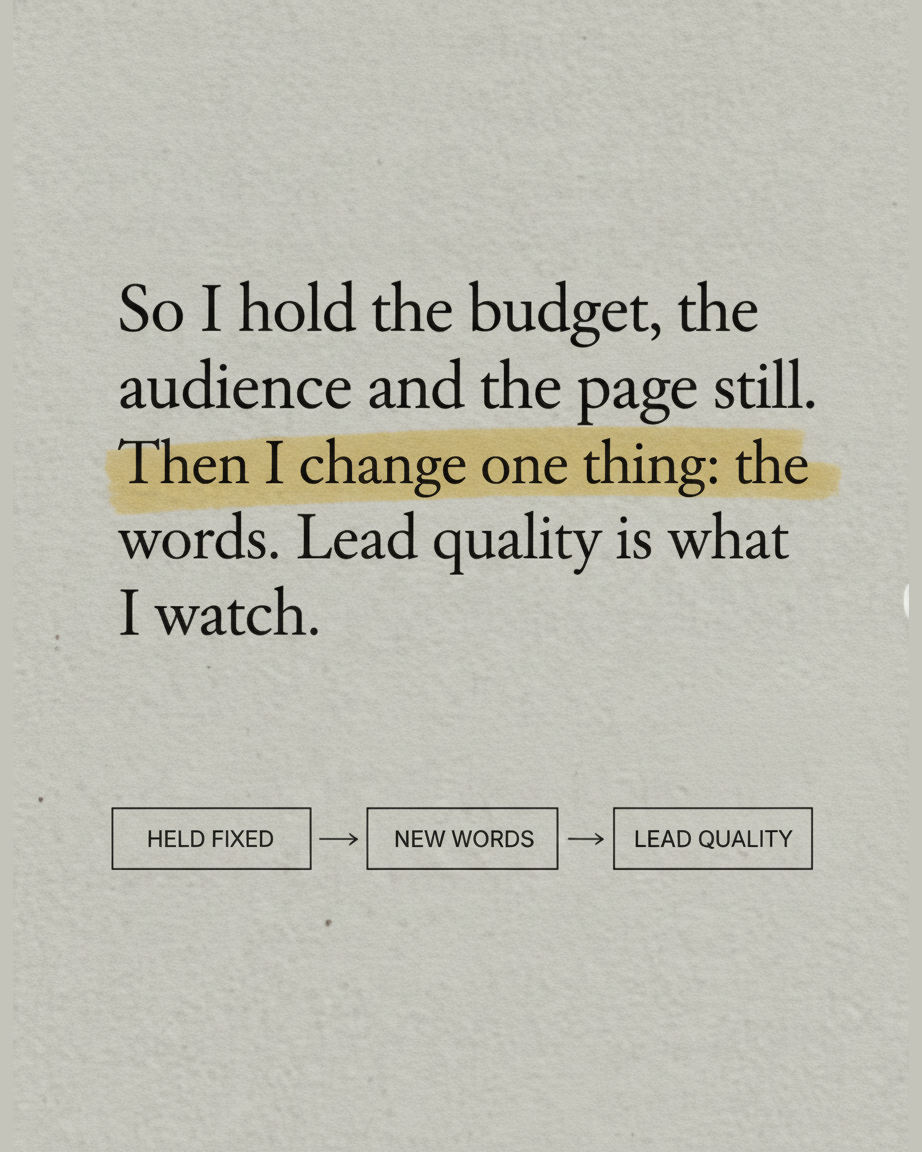
The discipline is ordinary and most firms skip it. Fix the budget. Fix the audience. Fix the page people land on and the image they see. Then change one variable, the wording, and give it long enough to produce something you can read.
The measure matters as much as the method. We are not watching cost per lead or click through rate here, because both can improve while the practice gets worse. We are watching the quality of the people who arrive, judged against the client you actually wanted. That is the only output of this test that tells you anything about your fee.
Fifty enquiries and no clients
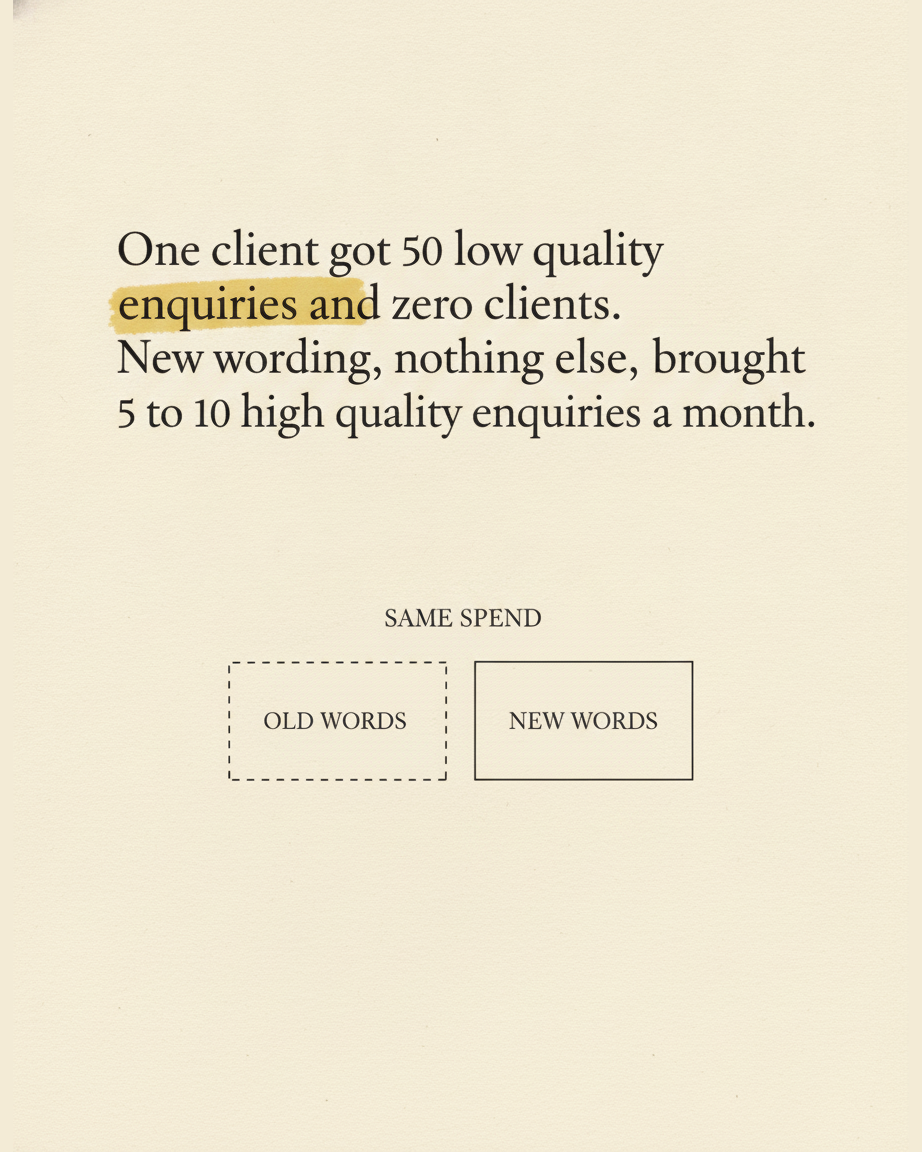
One client came to us with a number that looked healthy on a dashboard and meant nothing in the diary. Fifty low quality enquiries had come through, and none of them had become a client. Every one of them had cost somebody an email, a phone call or a wasted half hour.
We rewrote the wording. The spend stayed the same, the targeting stayed the same, the page stayed the same. What followed was five to ten high quality enquiries a month, from people who matched the work the firm wanted to do. The total went down and the practice got better.
Fit is what the count should measure
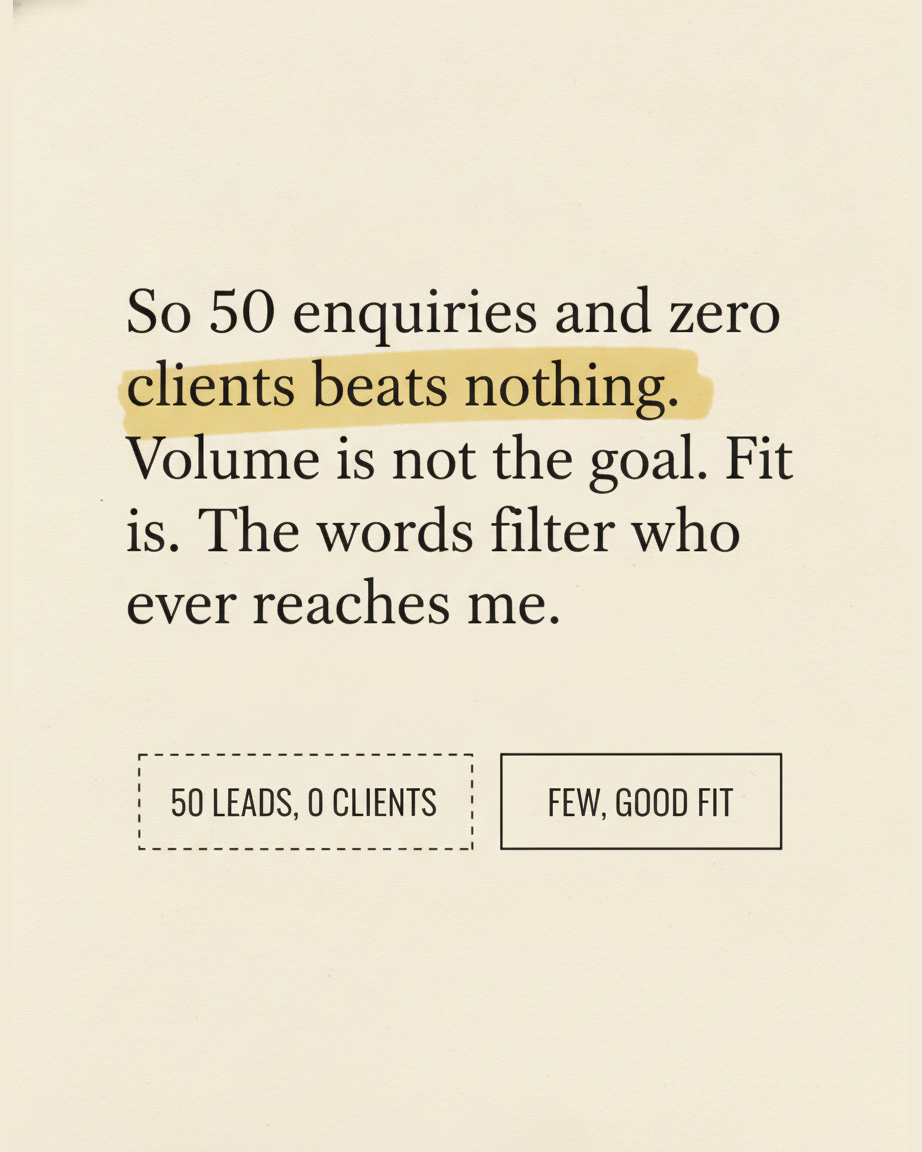
Fifty enquiries and no clients still beats an empty pipeline in one narrow sense. It proves the machinery works, that people see the ad and act on it. What it does not prove is that the offer is aimed at anybody you want.
The goal is fit, and volume is a poor proxy for it. A small number of well matched conversations will do more for a practice than a busy inbox that consumes the time of a senior person and converts nobody. The words are the filter that decides which of those two months you get, because they decide who ever reaches you in the first place.
The wording of an offer selects the buyer
This is the principle underneath everything above, and it is worth stating on its own. The wording of an offer selects the buyer. Naming a service and naming a client type is an act of exclusion, and the exclusion is the point.
A broad line about helping businesses with their accounts invites everybody, so everybody comes, and the sorting work lands on your team. A line that names a specific kind of firm and a specific piece of work tells most readers to move on. The ones who stay have already agreed with the premise before they type anything, which is why the conversation feels different.
What poor fit enquiries actually prove
Here is where the pricing argument comes apart. A run of poor fit enquiries tells you nothing about whether your work is worth what you charge, because the people who sent them were never in a position to judge that. They were answering a different question, put to them by an advert that described somebody else.
What those enquiries prove is that the wrong people arrived. That is a marketing result, and it has a marketing fix. Treating it as a verdict on your value means acting on evidence collected from an audience you did not want, which is a strange basis for any decision about a fee.
The cost of judging by lead count
The damage from this mistake compounds quietly over a year. Sales hours go into calls that were never going to close. Junior staff learn that enquiries are usually a waste of time and start treating the good ones the same way. Nobody signs, so confidence in the offer drops.
Then the fee comes down, because the fee is the visible lever and the wording is not. The firm ends up serving a market it did not choose at a rate it did not want, still running the advert that caused the problem. It is an expensive year, and none of it required a bad decision, only a misread one.
Rewrite only the words, name both
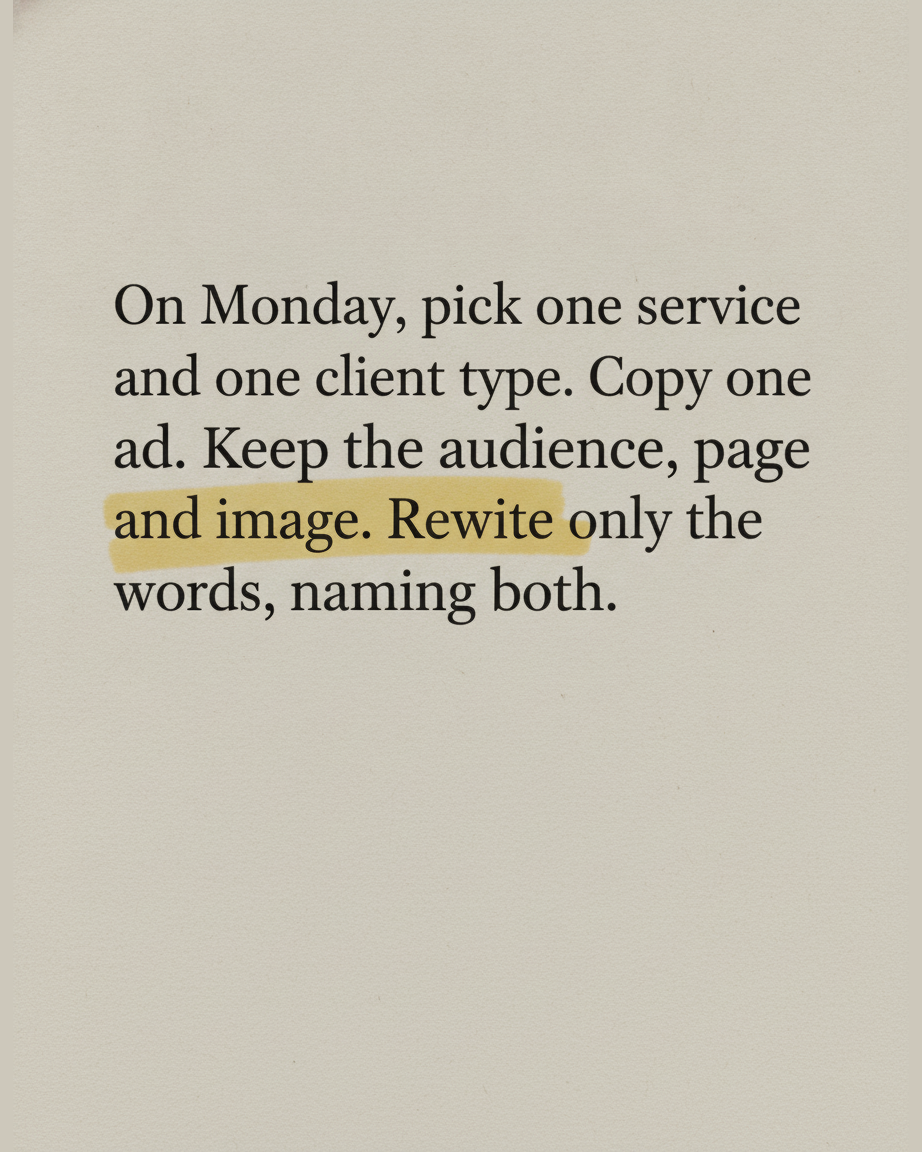
On Monday, choose one service and one kind of client. Take an advert you are already running. If you have nothing running, write a broad control version first, because you need something to compare against.
Duplicate it. Keep the audience, the landing page and the creative identical, then rewrite the second version so it names that client type and that service in plain terms. No hedging language, no list of everything else you do. The whole value of the test comes from the fact that one variable moved, so resist the urge to improve the image or tidy the page while you are in there.
Count matching enquiries, not leads
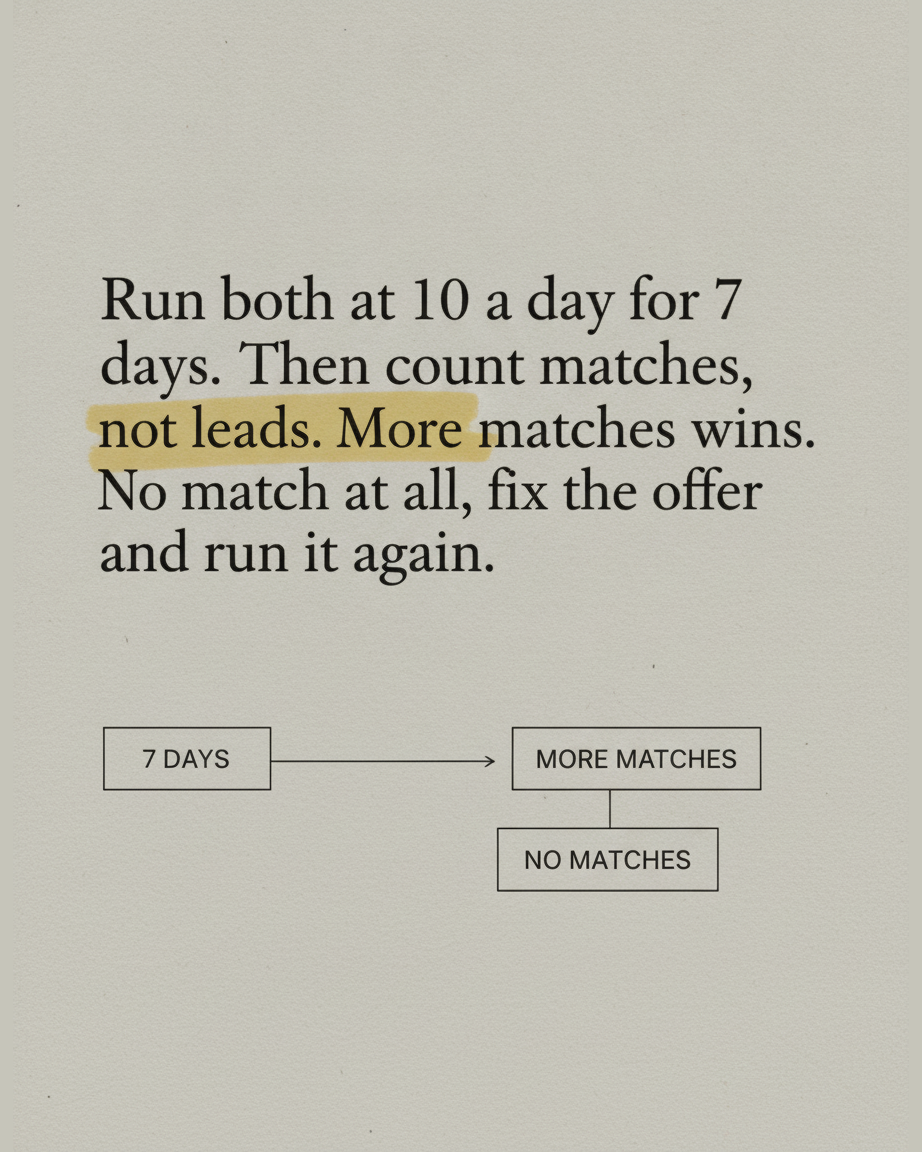
Run both versions on the same small daily budget for seven days. Before you launch, write down what counts as a matching enquiry: someone who fits the named client type and is asking about the named service. Deciding that afterwards is how firms talk themselves into the wrong answer.
After seven days, compare matches rather than totals. Keep the wording that produced more of them. If one version brought more volume and fewer matches, reject it, whatever the cost per lead says. If neither version produced a single match, the offer itself needs work, so revise it and run again rather than cutting your fee on an inconclusive test.
Keep this for the next bad week
The moment this matters is not today, while you are reading calmly. It is the Friday after a week of poor enquiries, when the inbox has been busy and the diary has not, and somebody in the room says the market will not pay it.
That is the point to run the test rather than the discount. A week of evidence costs very little and it answers the question properly, which is more than a fee cut will do. If the wording is wrong, you will know by the following Monday, and you will have kept a price you can still build a practice on.
Test the words first
Poor enquiries are information, and the information they carry is about who your marketing is describing. Sometimes the fee genuinely is wrong for the market you have chosen, and a well run test will show you that too. The difference is that you will be deciding with evidence from the right audience instead of the wrong one.
So before the next round of discounting, spend a week naming one client and one service and see who answers. Change the sentences, hold everything else still, and count matches rather than leads.
If your firm looks like the one described here, with a busy inbox and a quiet diary, we are happy to look at the wording with you and give you a straight read either way.