You do not need to understand the channel to judge it
Most partners approve marketing spend they cannot assess, then wait a year to find out whether it worked. There is a faster way: test for demand inside seven days, then follow every enquiry through to annual recurring fees. This is for firm owners who want a straight answer rather than a supplier explanation.
Every firm owner we speak to has the same quiet problem with marketing spend. The invoices arrive, the reports arrive, and nobody in the room can say with confidence whether any of it created a client. So the decision gets made on tone of voice, on how convincing the agency sounded, on whether the dashboard looked busy.
Our position is simple. You do not need to understand search, cold email or paid social to judge them. You need a seven day marketing test that tells you whether the market replies, and then a chain of numbers that follows each enquiry through appointments and proposals to annual recurring fees.
What follows is the test itself, two real sets of figures, and the thresholds we use to read the result.
What ten pounds a day actually produced
A practice that doubted the whole idea added 10,430 pounds in yearly fees over six months. For three of those months, the ad spend was ten pounds a day. We lead with that figure because it reframes the question. The debate in most partner meetings is about budget size, when the real variable is whether anyone is checking what the budget produced.
Small spend, tracked properly, teaches you more than large spend reported loosely. That is the whole basis of the test we are about to describe, and the reason we start with seven days rather than a twelve month retainer.
Judging on vibes is still judging
If the rule is that you must grasp how search rankings or ad auctions work before you can assess them, then you have handed the decision to the person selling you the service. You pick on vibes. You wait for the supplier to explain, and the explanation always arrives dressed as progress.
We see this in firms that are otherwise rigorous about numbers. The same partner who would never accept a management account without a reconciliation will accept an impressions chart without asking what it led to. The technical gap is real, and it is also not the thing standing in your way.
You do not need to understand the channel to judge it. You need to know whether the market replied, and whether the firm turned that reply into clients and annual recurring fees.
Growth leaves a chain you can count
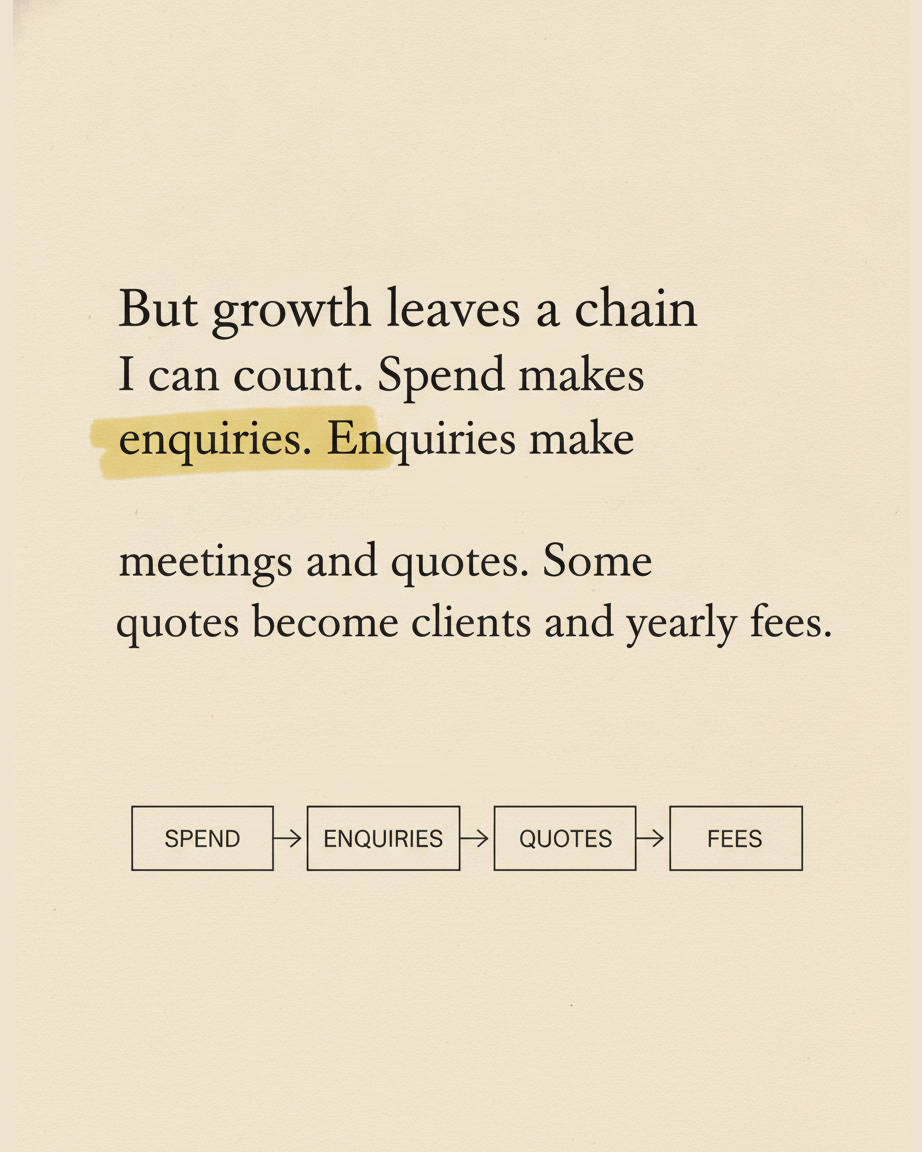
Here is what closes the gap. Whatever the channel, growth leaves the same chain behind it, and every link in that chain is countable without any technical knowledge at all.
Spend produces enquiries. Enquiries produce meetings and quotes. Some quotes become clients, and those clients carry annual recurring fees. That is four numbers. You can ask for all four in a single email, and the quality of the answer tells you most of what you need to know about the supplier as well as the channel.
When a report cannot show you the chain, it is describing activity rather than results.
Seven days beats a year of opinion
The principle underneath all of this is short. Seven days and a small budget will tell you more than a year of opinion.
Opinion is what fills the gap when nobody has evidence. It is why the same marketing conversation recurs at every partner meeting without resolving, and why channels get adopted and abandoned on the strength of who spoke last. A short live test replaces that argument with a number, and the number is available before the next meeting rather than after the next financial year.
The rest of this piece is the evidence that the test works, followed by the test itself.
Thirty five leads in under a week
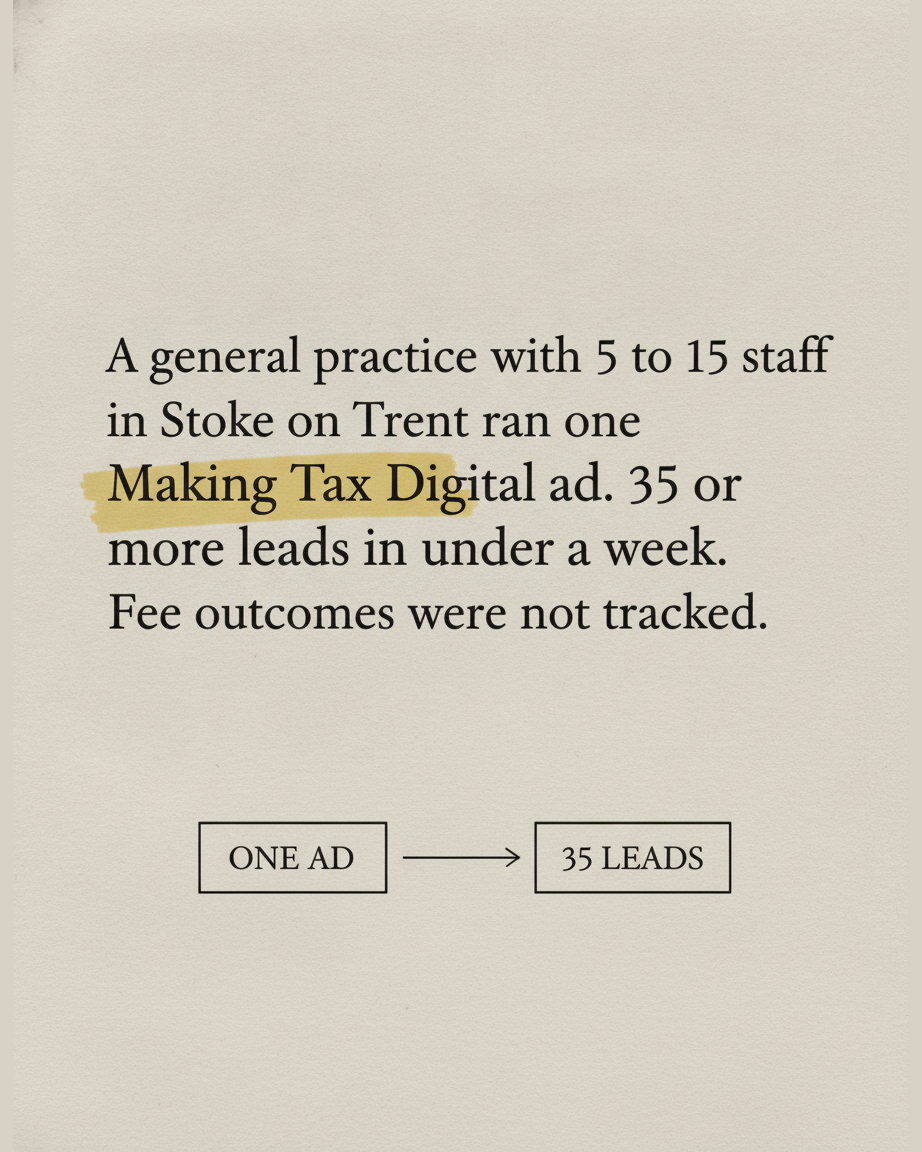
A general practice in Stoke on Trent with five to fifteen staff ran a single ad built around Making Tax Digital. It produced thirty five or more leads in under a week.
That is a clean reading of demand. One service, one deadline driven reason to act, one audience, and the market answered quickly enough that nobody needed to argue about it. We would be overstating the case if we stopped there, so it is worth saying plainly that fee outcomes from this test were never tracked. The firm learned that people wanted the service. It did not learn what that interest was worth.
Eighty one leads, still no tracked fees
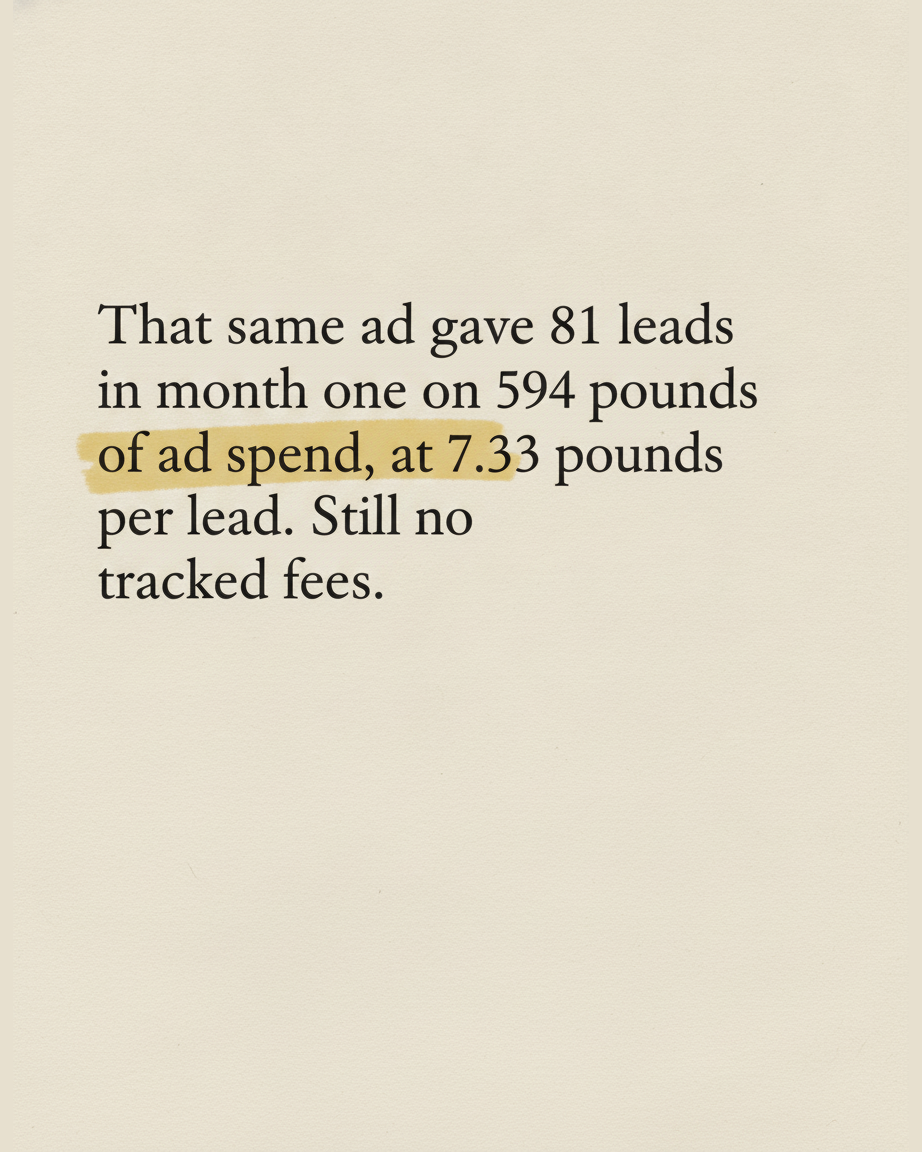
The same ad kept running. In month one it produced eighty one leads on 594 pounds of spend, which works out at 7.33 pounds per lead. On any media buying measure that is an efficient result, and it is exactly the kind of figure that gets presented to a partner group as proof.
It is not proof. The firm still had no record of how many of those eighty one people booked an appointment, how many received a proposal, or how many signed. The cost per lead was precise and the commercial outcome was unknown, which is a more common combination than most reporting admits.
A lead is not a fee
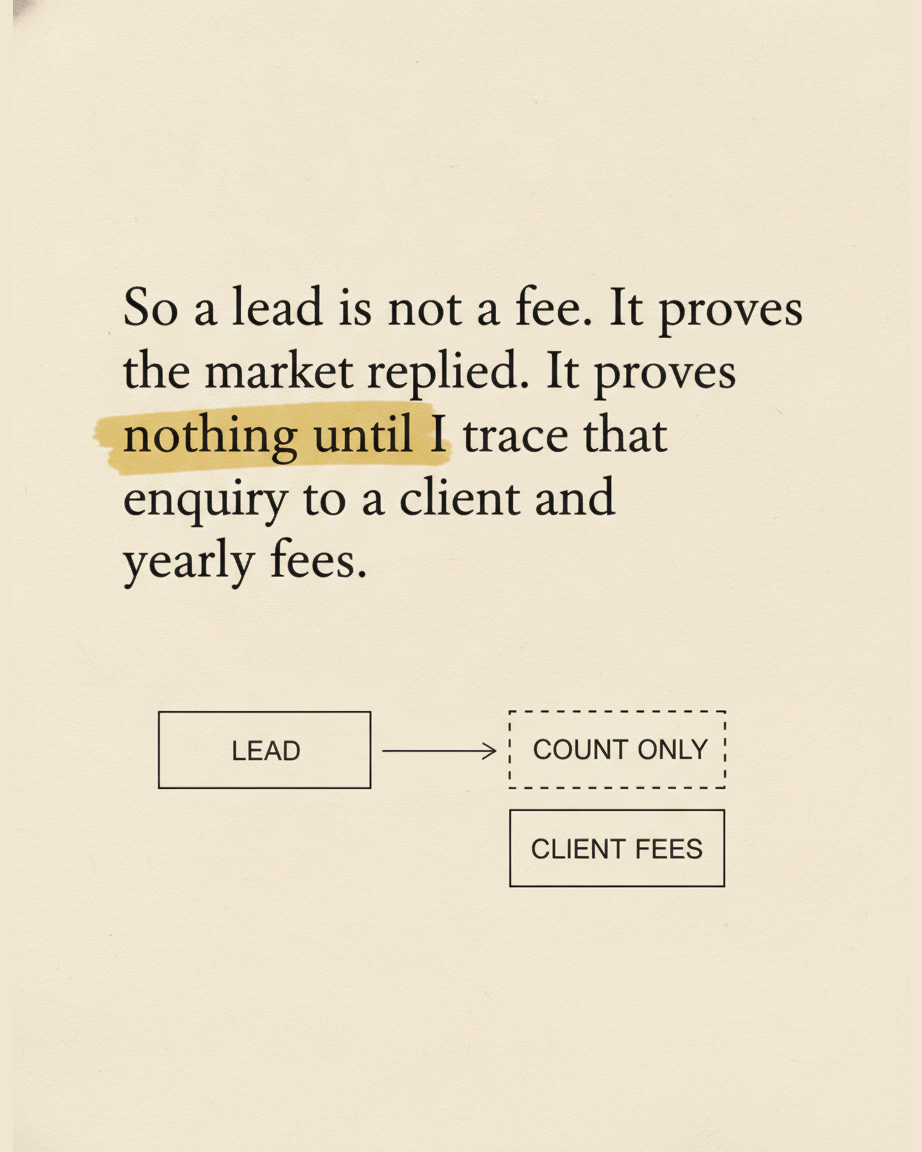
So the distinction has to be held firmly. A lead is not a fee. It proves the market replied, which is genuinely useful and genuinely limited.
Everything after the reply belongs to the firm. Whether someone answers the phone within the hour, whether the appointment gets booked while interest is still warm, whether the proposal goes out in two days or two weeks. A channel can deliver volume into a practice that has no capacity to convert it, and the honest conclusion in that case is about the practice.
Counting leads is where most firms stop. Tracing them to signed clients and annual recurring fees is where the judgement actually gets made.
Eleven clients traced all the way through
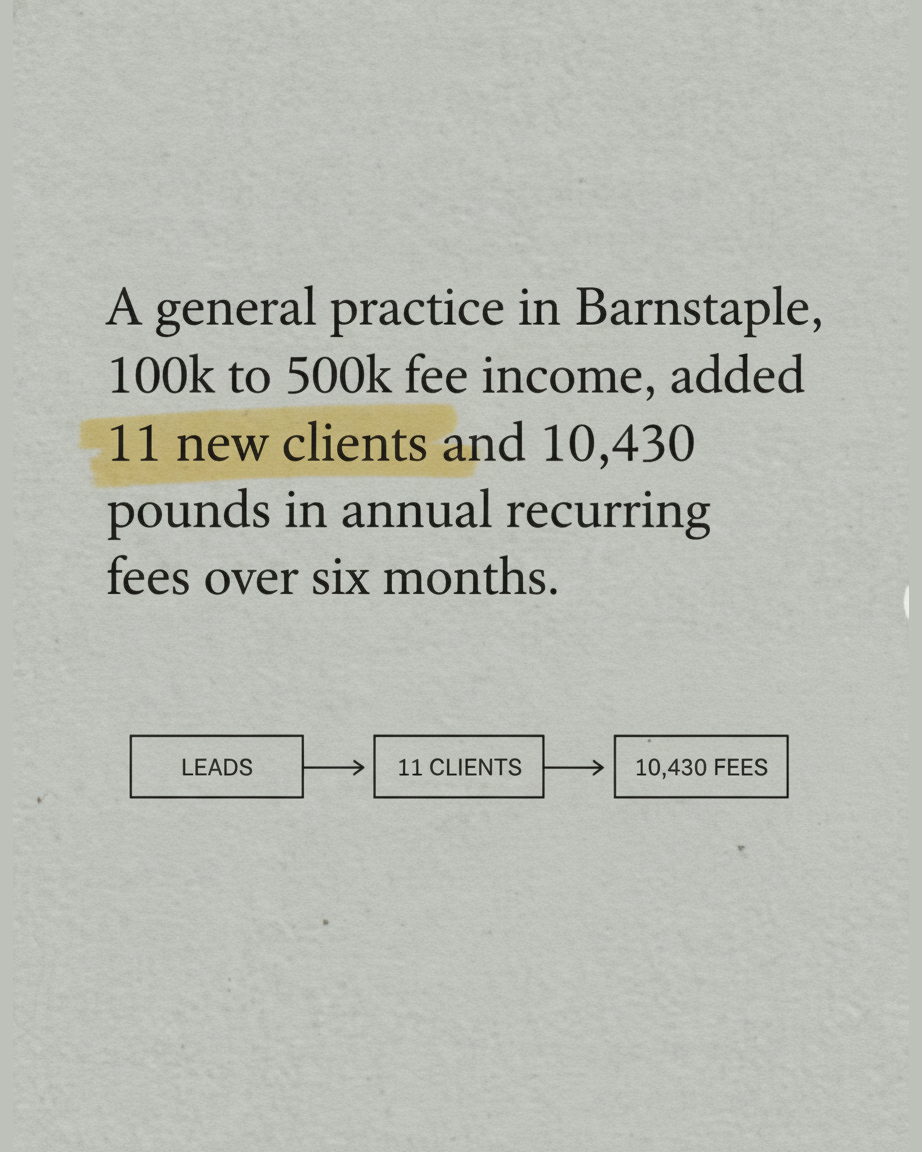
The Barnstaple practice is the counterexample, and it is the one we return to most often. A general practice with fee income between 100k and 500k added eleven new clients and 10,430 pounds in annual recurring fees over six months.
The difference from the first example is not the channel or the creative. It is that somebody kept a record. Every enquiry was followed to an appointment, every appointment to a proposal, and every proposal to a decision. That record is what turns an advertising result into a commercial one, and it is the part no supplier can build for you.
The conversion rates behind the return
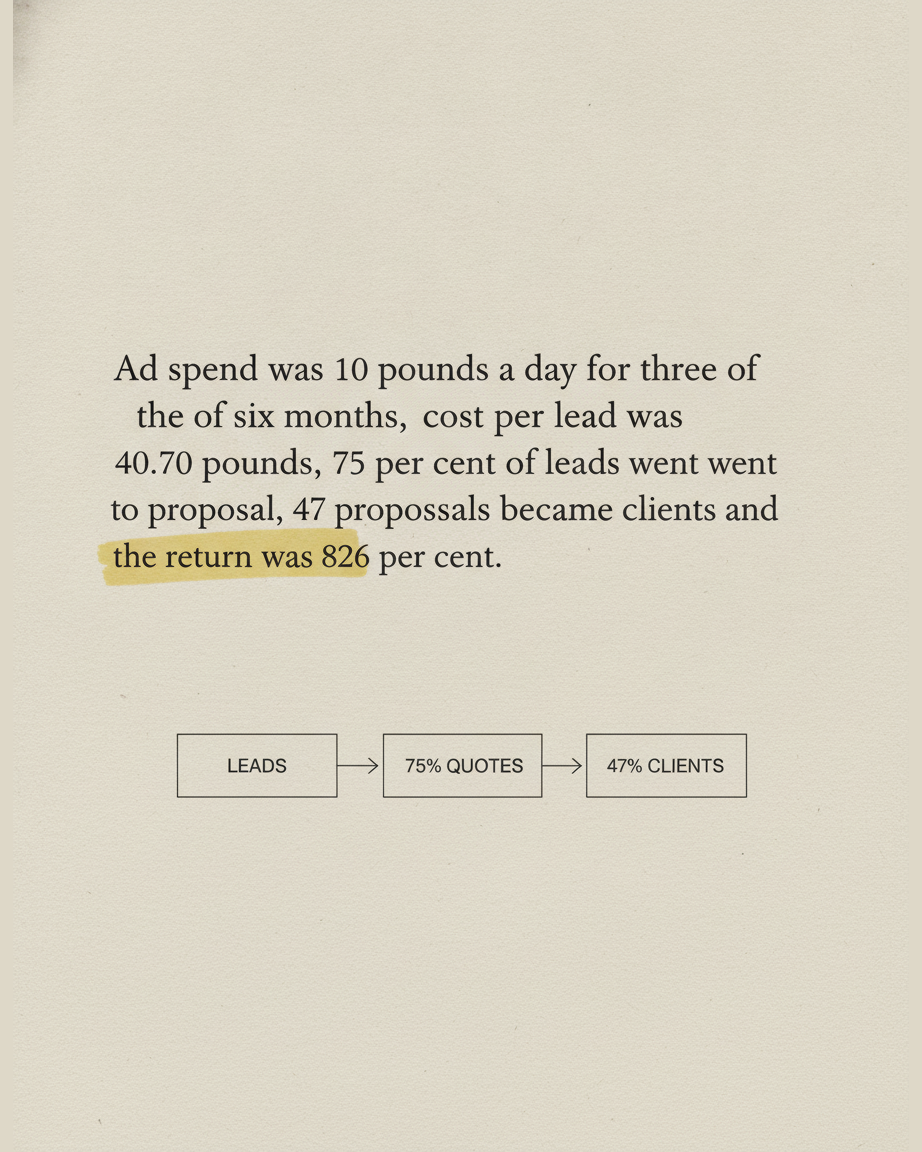
The detail is where the lesson sits. Ad spend was ten pounds a day for three of the six months. Cost per lead came in at 40.70 pounds, more than five times the Stoke on Trent figure. Seventy five per cent of leads went to proposal, forty seven per cent of proposals became clients, and the return was 826 per cent.
Read those two cases side by side and the usual assumption inverts. The cheaper leads produced no recorded fees. The more expensive leads produced a strong return, because the practice behind them converted. Cost per lead on its own is not a measure of anything commercial.
Judge it in two questions, in order
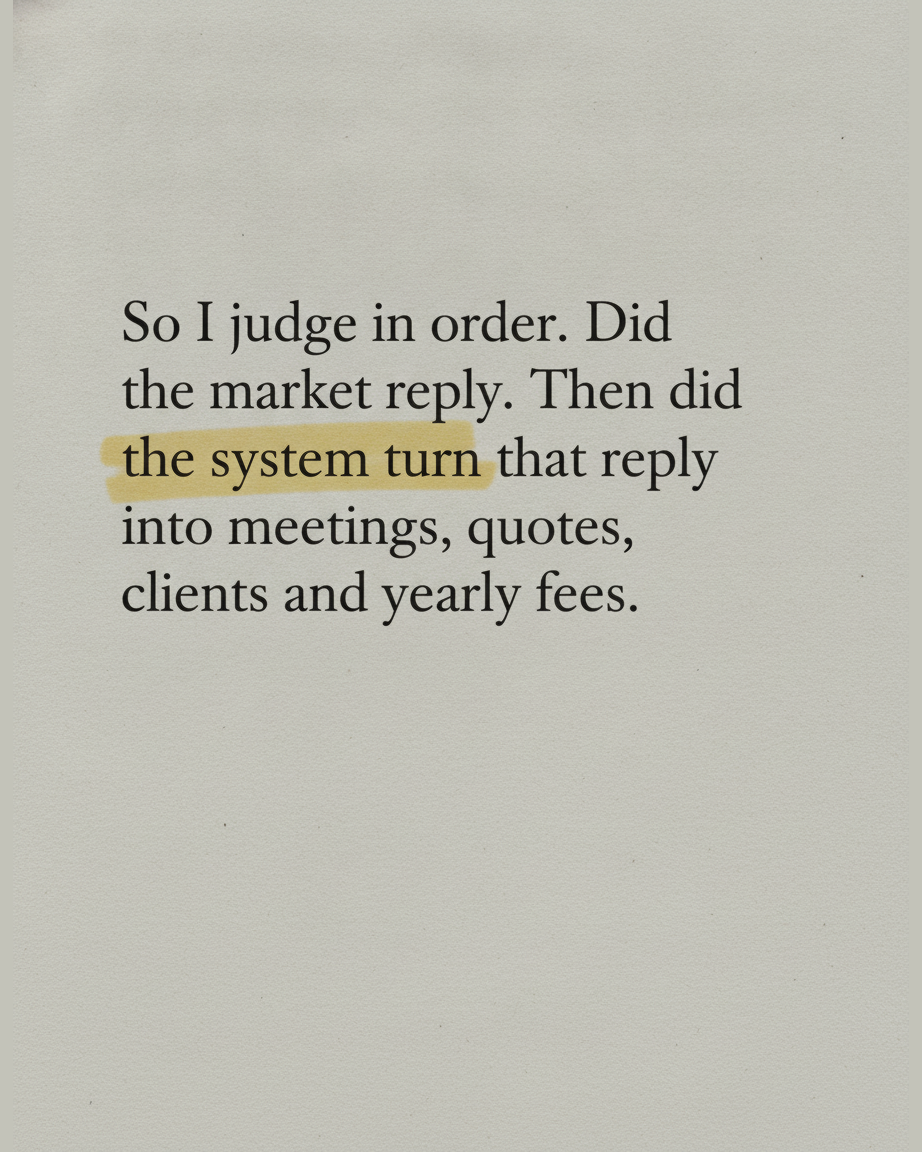
That gives you a sequence rather than a verdict. We judge marketing spend in two questions, and the order matters.
First, did the market reply. If nobody enquired, there is nothing downstream to measure and the conversation is about the offer and the words used to describe it. Second, did the firm turn that reply into meetings, quotes, clients and annual recurring fees. If enquiries arrived and nothing happened after that, the channel worked and the follow up did not.
Asking both questions at once is what produces the muddle most firms are stuck in. Asking them separately gives you two clear answers and two different fixes.
How to run the test on Monday
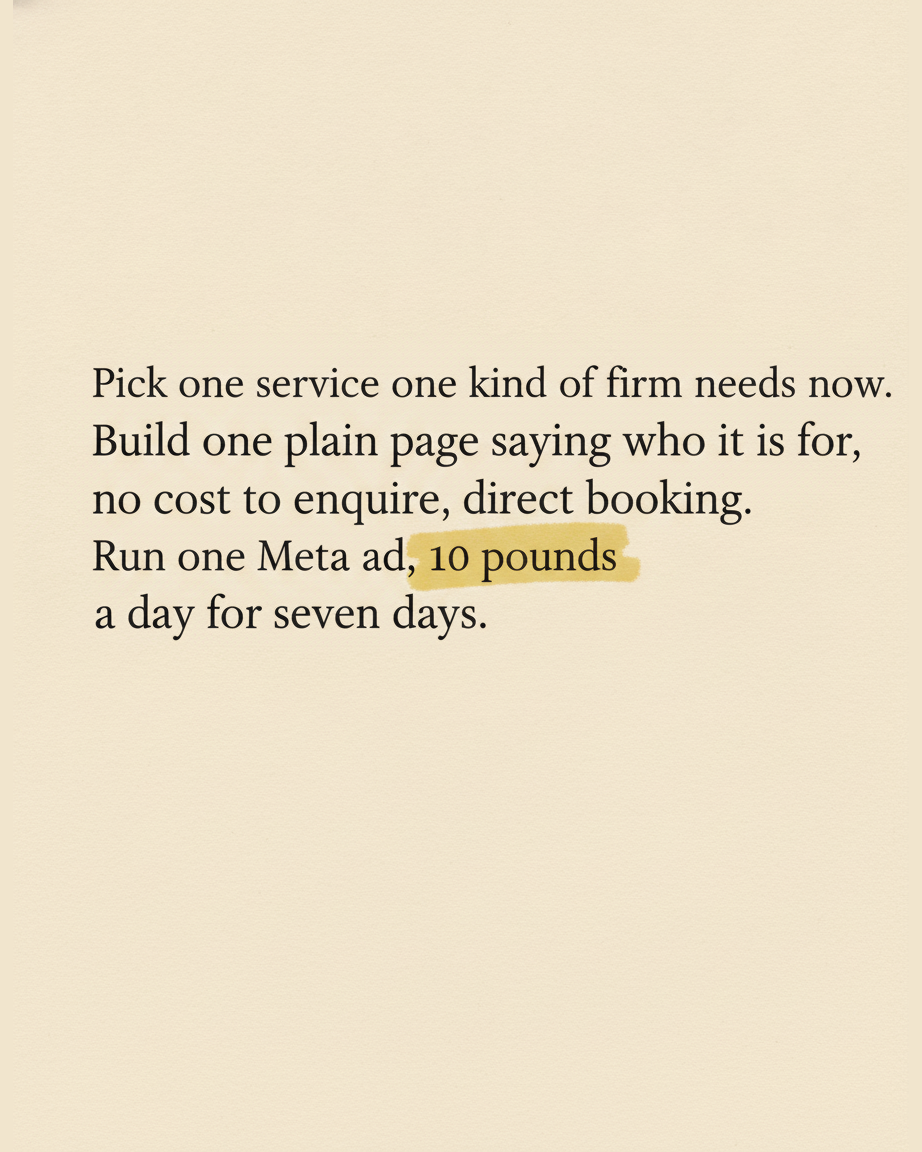
Here is the test in full. Pick one service that one specific kind of business needs right now, because of a deadline, a start up or a switch of provider. Urgency is doing most of the work, so resist the temptation to advertise everything the firm does.
Build one plain page on the firm's website. It says who the service is for, it makes clear there is no cost to enquire, and it offers direct booking rather than a contact form that lands in a shared inbox. Then run one Meta ad to that page at ten pounds a day for seven days. That is the entire setup.
Reading the result without arguing
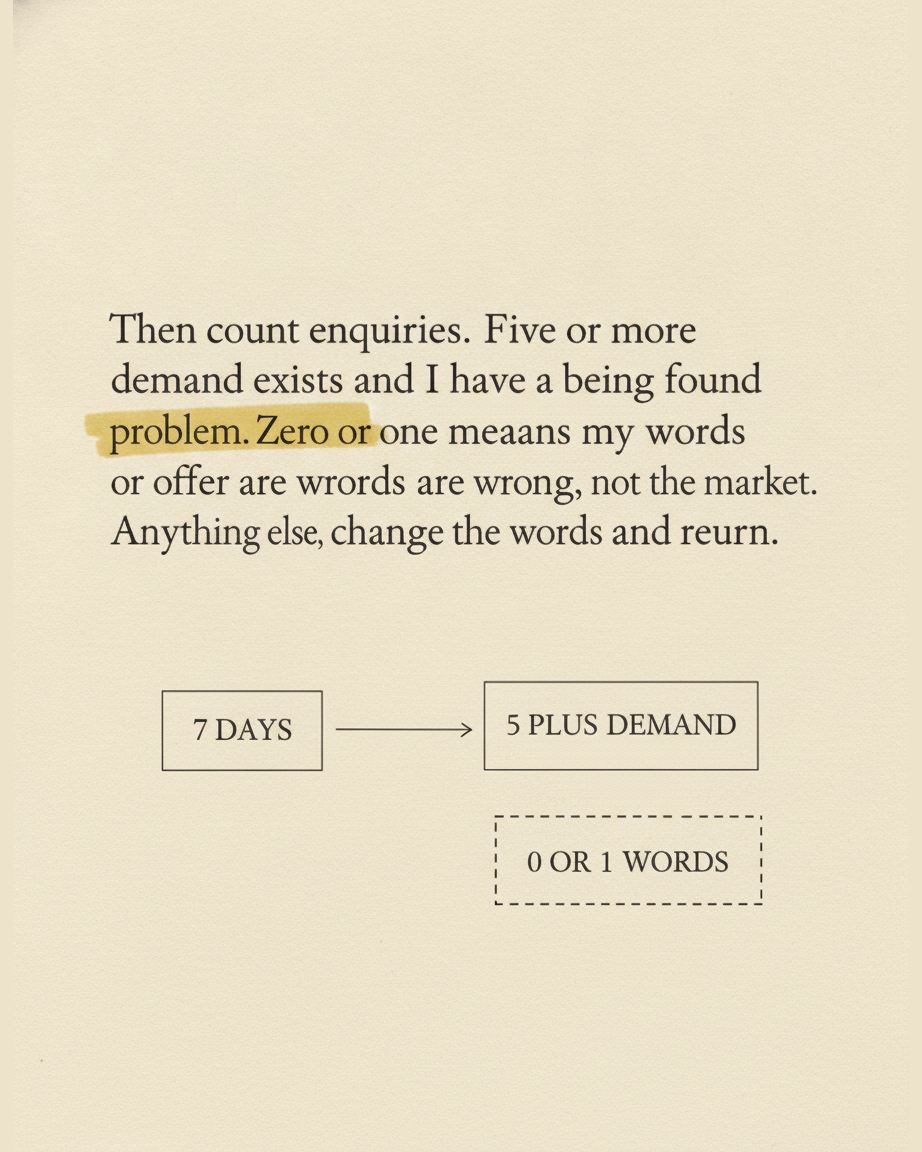
At the end of the week, count enquiries. Five or more means demand exists, and the firm's problem is being found rather than being wanted. Zero or one means the words or the offer are wrong, which is a fixable thing and quite different from the market being dead.
Anything between those two thresholds is inconclusive. Treat it as such, change the words or the offer, and run it again. The value of agreeing the thresholds before the test starts is that nobody gets to reinterpret the outcome afterwards, which is where most internal marketing debates actually go wrong.
Where this leaves you
Skip the test and another year can pass paying for activity nobody can verify, or killing channels before they were given a fair reading. Both outcomes leave budget and fees unmeasured, and both are avoidable in a week.
We are not claiming seven days settles everything. A single test tells you whether the market replies to one offer, which is the first question and only the first. The chain from enquiry to appointment to proposal to annual recurring fee is the part that takes months to build properly and is worth more than any channel decision.
Save this for the next time somebody asks you to approve spend with no written targets for enquiries, clients and fees. If your firm looks like the ones described here, we are happy to talk it through.