You can test demand in seven days before you build anything
Most firms decide whether paid acquisition works by arguing about it rather than measuring it. There is a cheaper way to settle the question, and it takes a week. This is for practice owners who have grown on referrals and want evidence before committing to a system.
Every firm that has grown on word of mouth eventually asks the same question. Would a repeatable acquisition system actually work here, or is it another marketing spend that disappears without a trace? The honest answer is that nobody in the room knows, and the discussion usually ends where it started.
A seven day demand test replaces that discussion with a number. One service, one clearly defined buyer, one plain page and a small daily budget for a week. At the end you count enquiries, and the count tells you whether people in your market will put their hand up for what you sell.
What follows is how we run it, what the figures mean, and the three outcomes you should prepare for before you start.
Thirty five leads in under a week
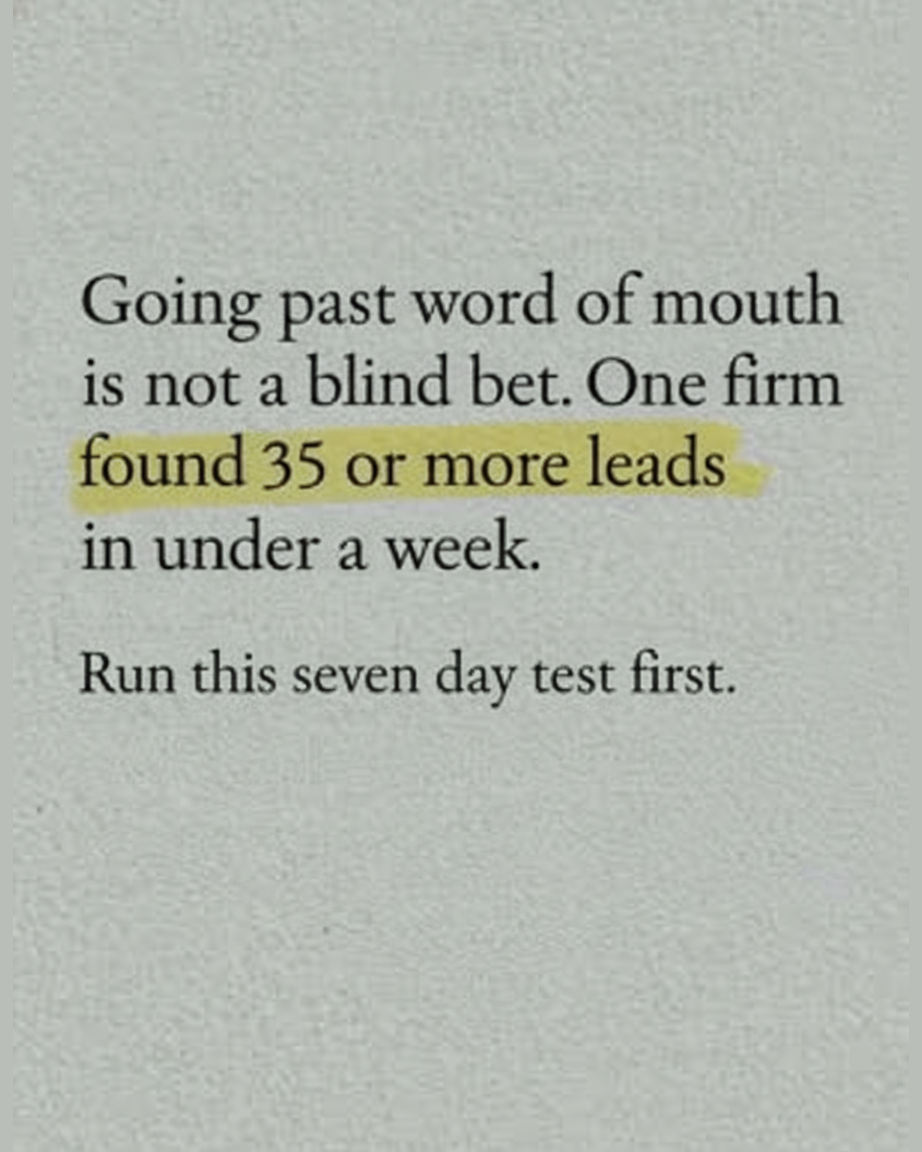
Going past word of mouth is treated as a leap of faith, and that framing is what keeps most practices where they are. It is reasonable to be wary of a channel you have never used. It is less reasonable to call the whole thing unknowable when a week of evidence is available for the price of a client lunch.
One firm we worked with found thirty five or more leads in under a week from a single offer. That is not a promise of what your market will do. It is proof that the question is answerable quickly, and that the answer tends to arrive faster than the planning cycle most firms run first.
Why it does feel like a bet
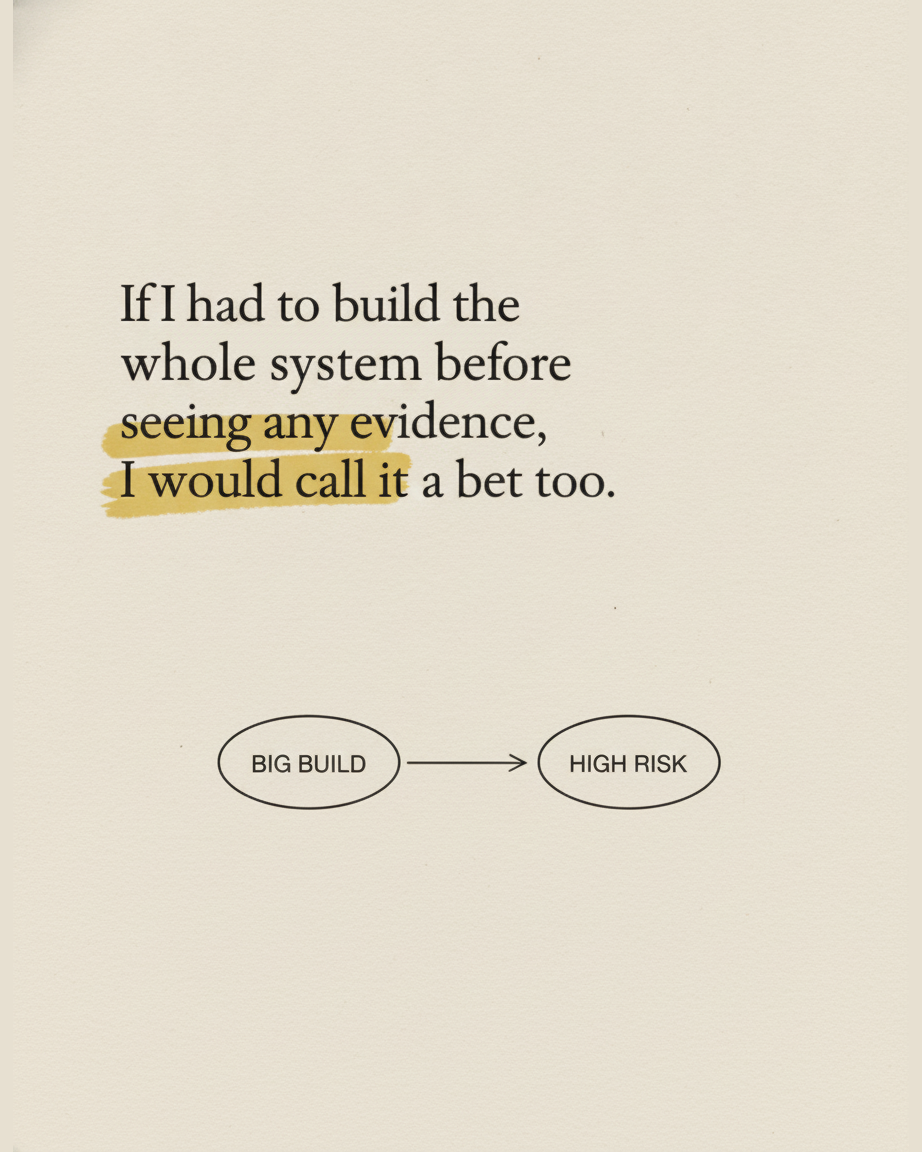
The caution is earned. If the only route into paid acquisition is to commission a website, write a brand story, build nurture sequences and hire someone to run it, then yes, you are committing real money and partner time before a single piece of evidence arrives. We would call that a bet too.
The flaw sits in the sequencing rather than the ambition. A big build carries high risk precisely because the question it is meant to answer stays open until the build is finished. Reverse the order and the risk collapses. Find out whether anyone replies, then decide what deserves building around the reply.
Seven days and a small budget will tell you more about demand than a year of opinion, because an enquiry count answers a question that meetings are structurally unable to settle.
One service, one page, one ad
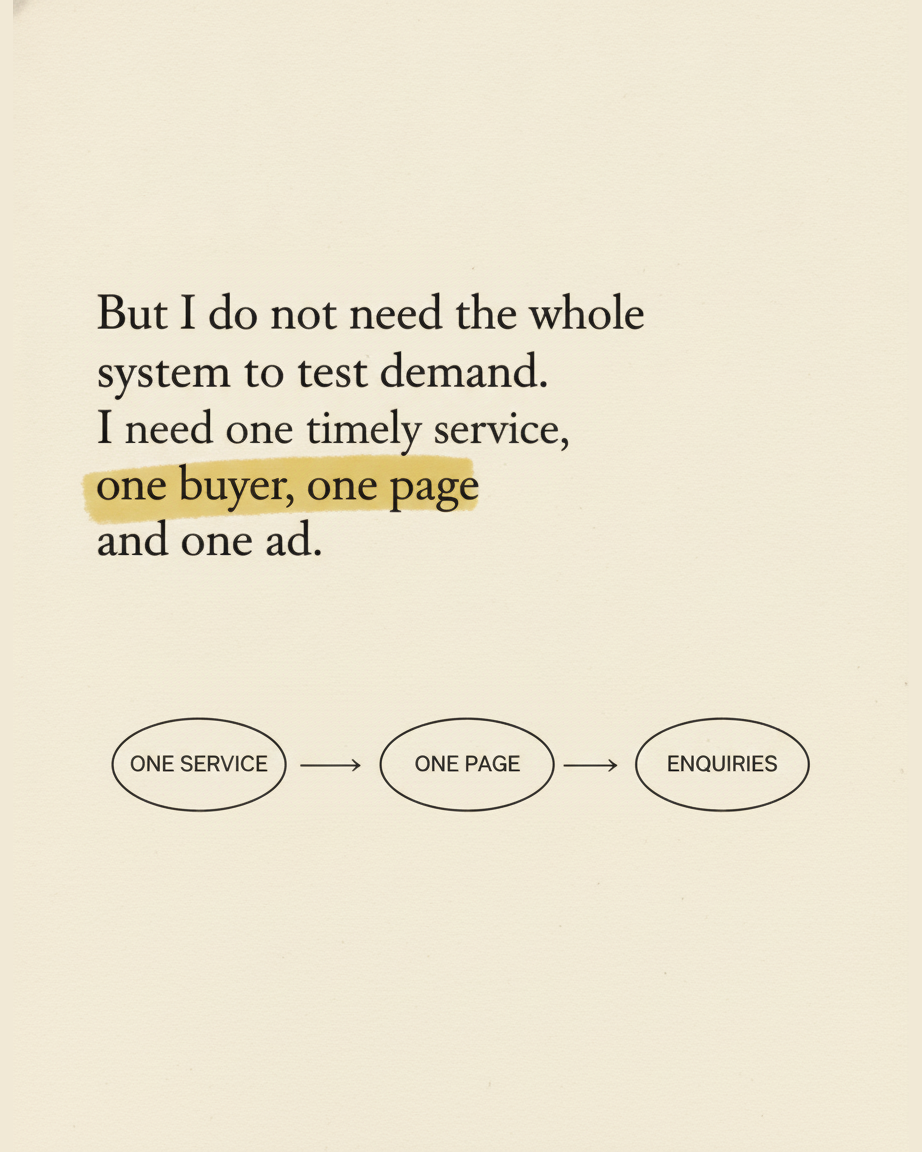
Testing demand does not require the system. It requires the smallest honest version of it: one timely service, one kind of buyer, one page and one ad. Everything else is scaffolding you can add later if the week justifies it.
The discipline is in the word one. The moment a test carries three services and two audiences, the result becomes unreadable, because you cannot tell which element failed. A single service pointed at a single buyer produces a clean signal. Enquiries arrive or they do not, and in both cases you know exactly which proposition the market was responding to.
What one deadline offer returned
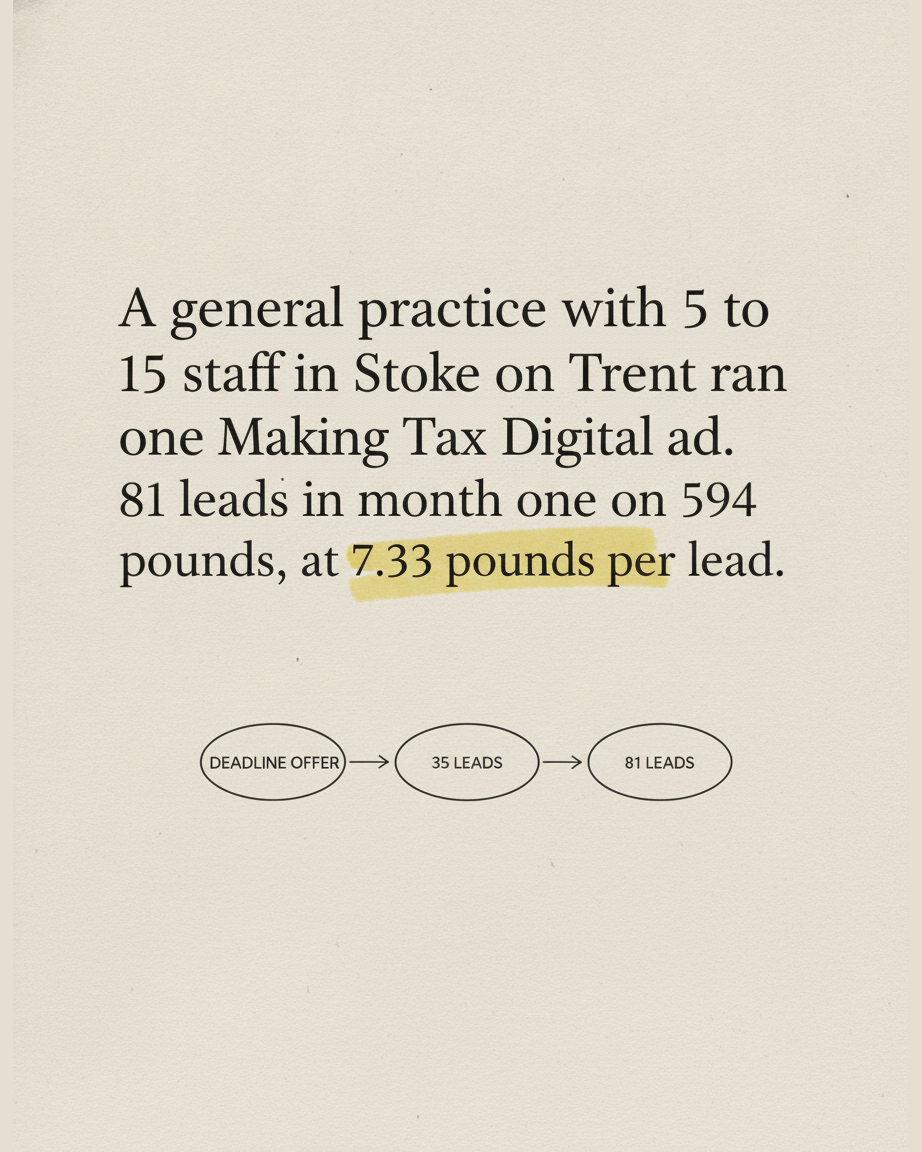
A general practice with five to fifteen staff in Stoke on Trent ran a single Making Tax Digital ad. In the first month it produced eighty one leads on five hundred and ninety four pounds of spend, which works out at seven pounds thirty three per lead.
The detail that matters is not the volume. It is that the offer was tied to a date in the calendar that the buyer could not ignore. A deadline creates a reason to respond this week rather than at some undefined point when the firm gets round to it. The first week carried most of the signal, and the rest of the month confirmed it.
Timing beats a list of services
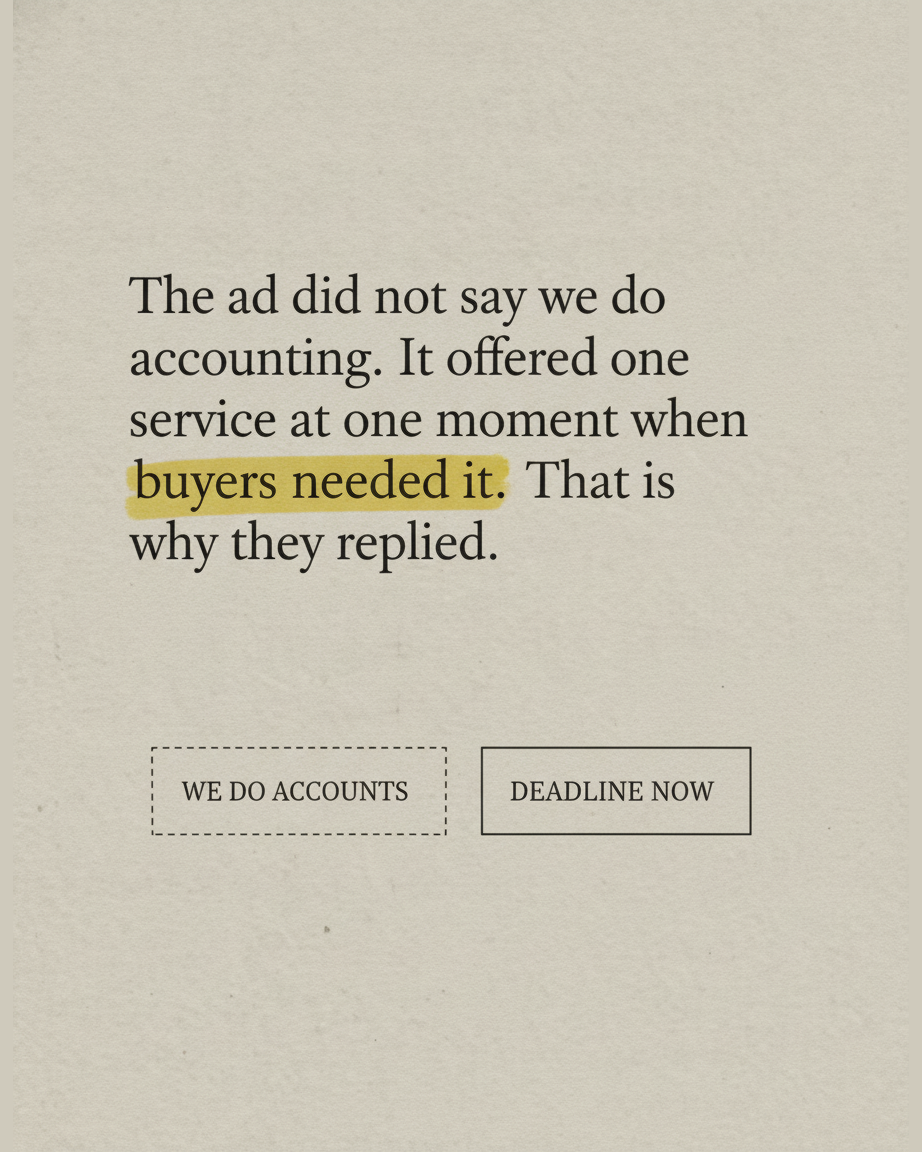
That ad never said we do accounting. Every firm says that, and it asks the reader to work out for themselves whether now is the moment to act. Almost nobody does that work on your behalf.
What the ad offered was one service at one moment when a specific kind of business needed it. A looming filing requirement, a company being formed, a switch away from an adviser who stopped replying. Those are the situations where a buyer is already half way to a decision, and the right message simply arrives at the right time. That is why people replied, and it is the hardest part of the test to get right.
What the test can and cannot prove
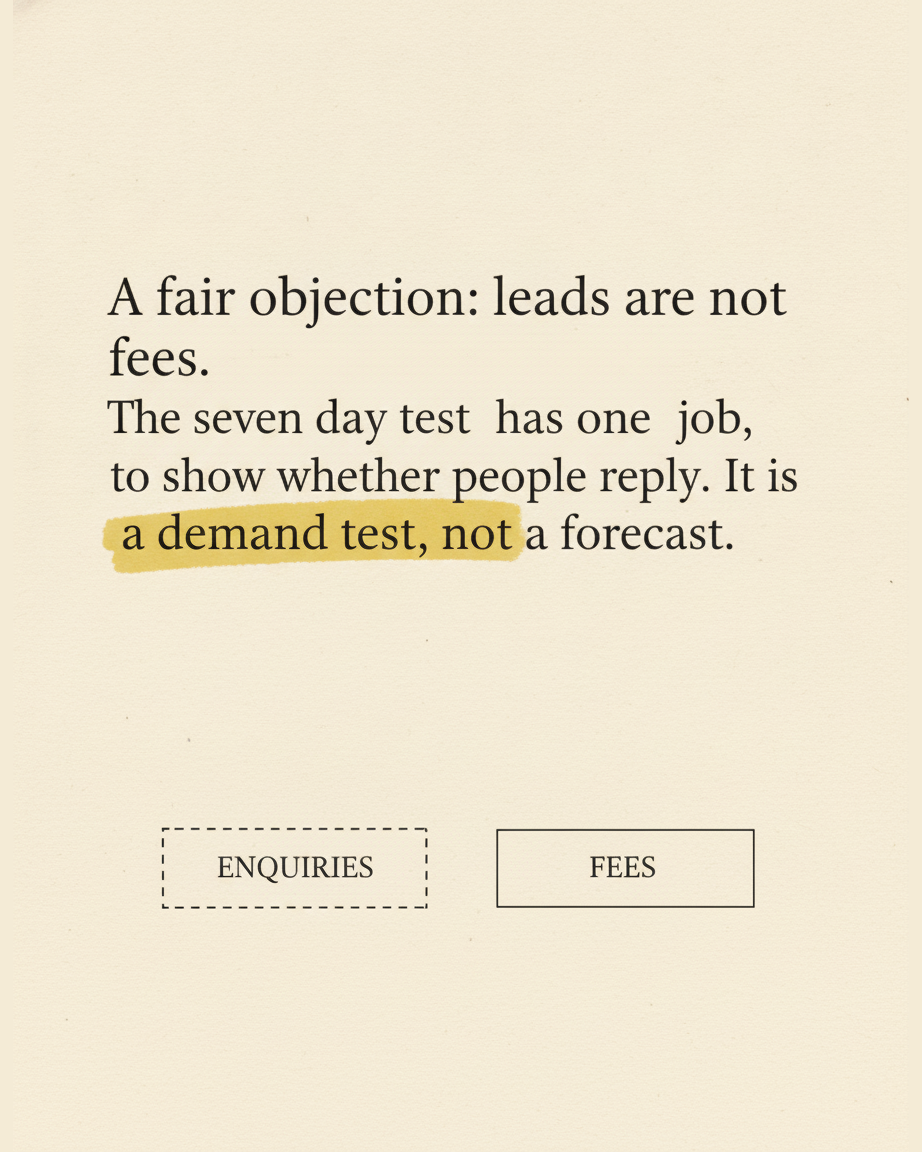
There is a fair objection here, and it should be said out loud rather than managed around. Leads are not fees. An enquiry is a person who raised their hand, and plenty of raised hands never become clients.
The seven day test has one job, which is to show whether people in your market reply to a clear offer. Treat it as a measure of demand rather than a revenue forecast. Conversion, pricing and capacity are separate problems with separate answers, and they are worth solving once you know there is something to convert. Asking a week of spend to predict annual fees is asking it to do work it was never built for.
Where the fees actually showed up
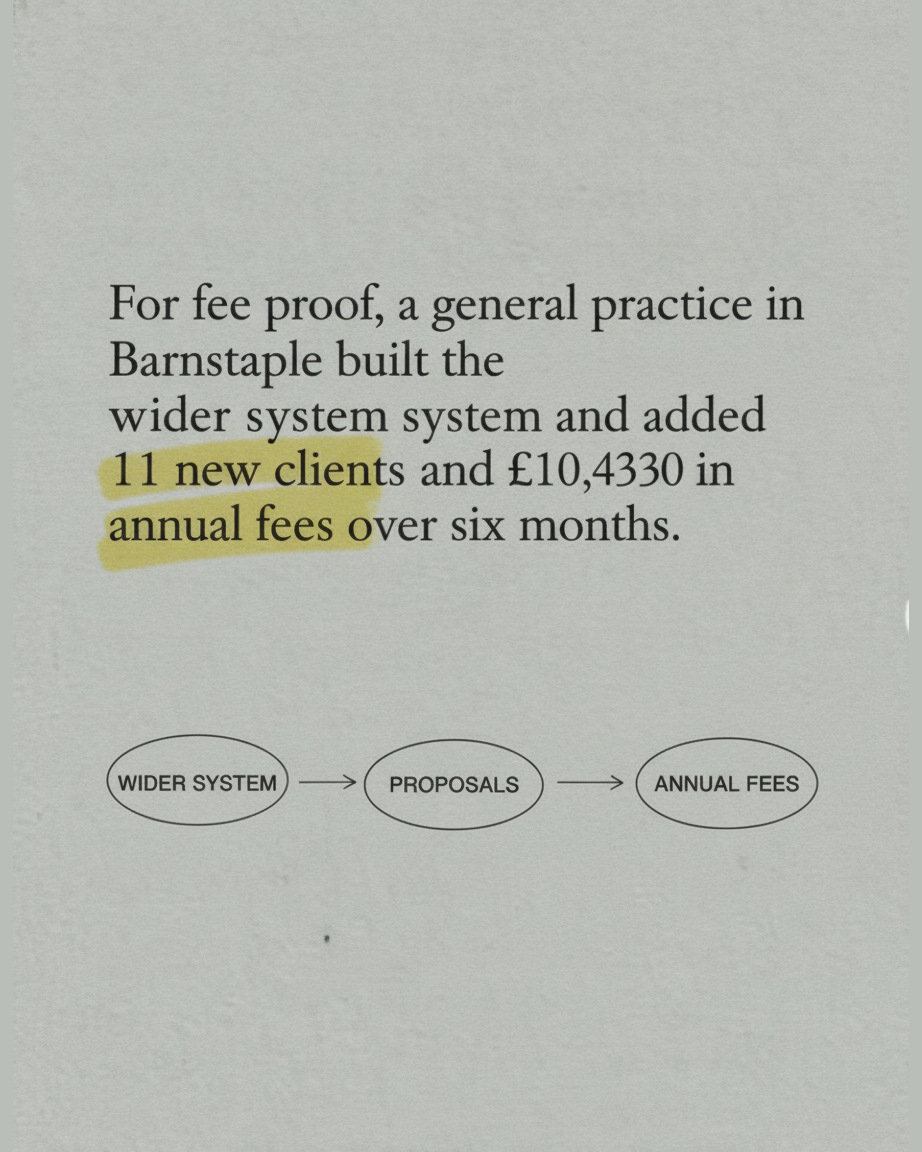
If you want evidence on the fee side, it exists, and it comes from the stage after the test. A general practice in Barnstaple built the wider system, with the follow up, the proposal process and the handling that turns an enquiry into a signature. Over six months it added eleven new clients and ten thousand four hundred and thirty pounds in annual fees.
Read those two examples in sequence rather than in competition. The week long test tells you whether to build. The build is what converts the demand the test uncovered. Skipping the first step is how firms end up with a system aimed at a market that was never going to answer.
What to do on Monday
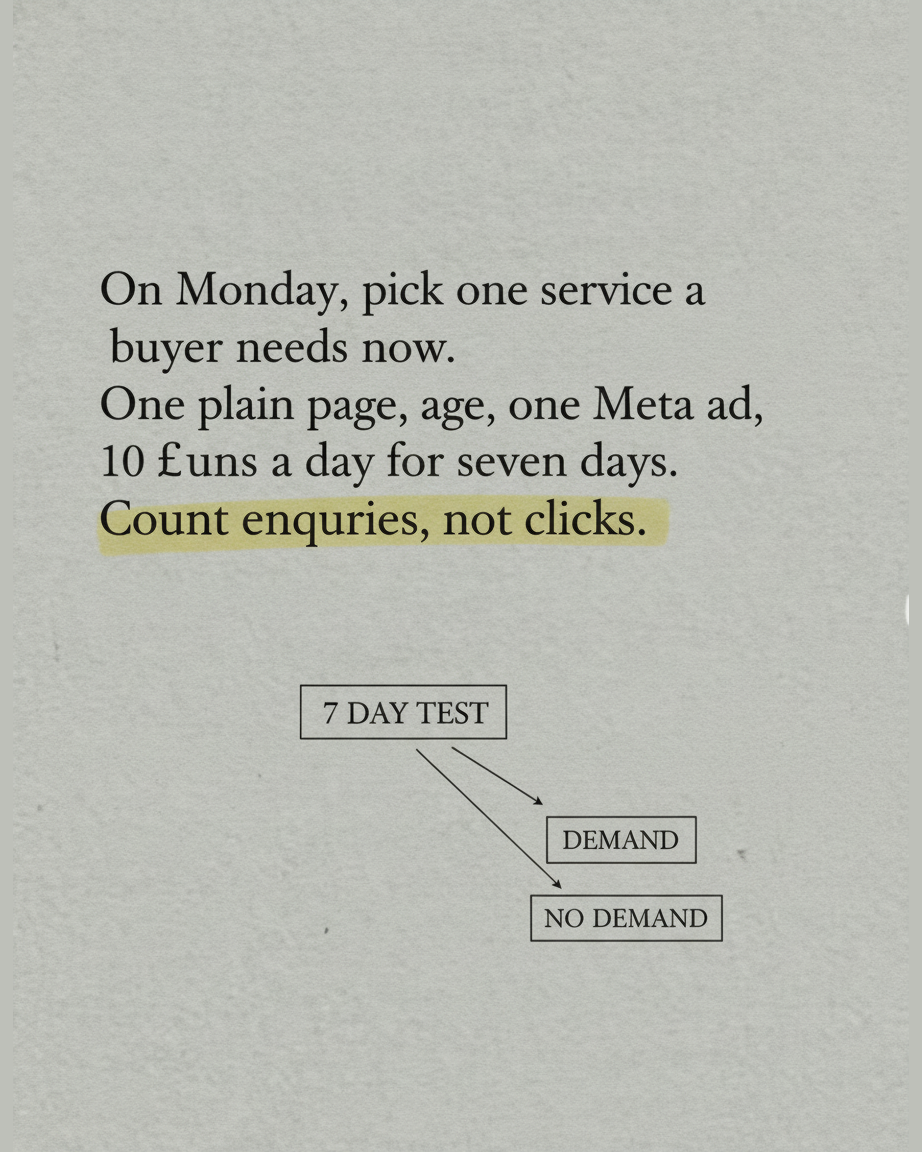
Pick one service that a specific kind of business needs now, driven by a deadline, a start up or a switch. Write one plain page that states who it is for, that it costs nothing to enquire, and how to book. No brand refresh, no photography, no navigation to get lost in.
Point one Meta ad at that page and spend ten pounds a day for seven days. Then count enquiries. Clicks and impressions will be sitting there in the dashboard asking for attention, and they tell you almost nothing about whether a business owner wants to speak to you. The enquiry count is the only figure that settles the question.
Reading the enquiry count honestly
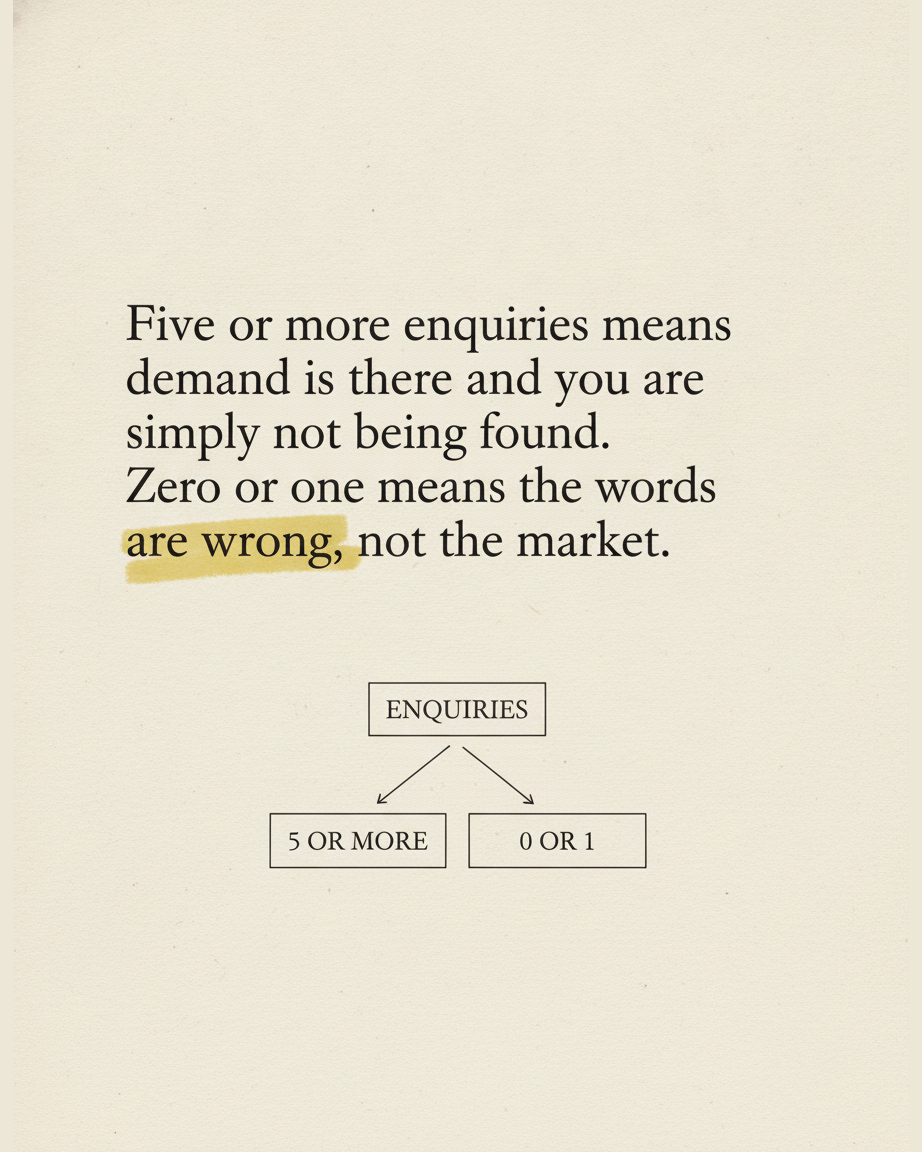
Five or more enquiries means demand is there and the firm has a visibility problem rather than a market problem. The buyers exist, they were simply never shown anything worth replying to.
Zero or one means the words or the offer are wrong. That is a writing problem, and it is fixable in an afternoon. Two to four is genuinely inconclusive, so change the wording or sharpen the offer and run it again before you draw any conclusion about the market. The discipline that makes this work is agreeing the thresholds before the week starts, because after the fact every number can be argued into whatever the room already believed.
The cost of another year waiting
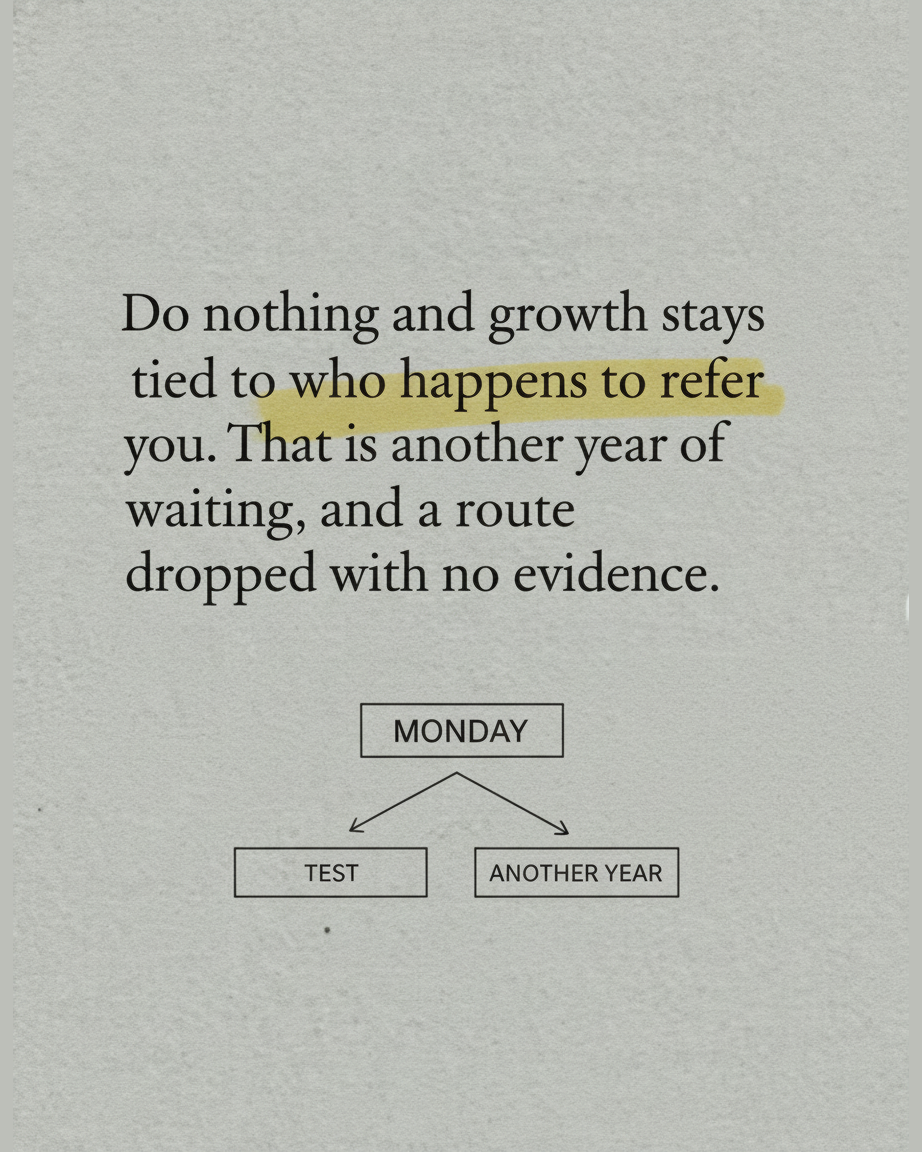
Doing nothing has a price, and it is easy to overlook because it never appears on a bill. Growth stays tied to who happens to refer you, which means the shape of next year is decided by other people's goodwill and their own workload.
That is another year of waiting, and a whole route to new clients dropped without a single piece of evidence against it. The firms that stay stuck are rarely the ones that tested and failed. They are the ones that kept the question open because keeping it open felt safer than finding out. A week of spend removes that excuse entirely.
Seven days against a year of opinion
The principle underneath all of this is simple enough to hold in your head during a partners' meeting. Seven days and a small budget will tell you more than a year of opinion, because opinion has no mechanism for being wrong and a count of enquiries does.
Whatever the number turns out to be, you end the week knowing something you did not know on Monday. Either demand exists and the job is visibility, or the offer needs rewriting, or the signal was too faint to call and you run it again. All three are better positions than the one you started from.
Where this leaves you
A repeatable acquisition system is a significant commitment, and we would not ask any firm to make it on faith. The seven day test exists so that the commitment comes second, after the market has already given you an answer you can point at.
It will not tell you what your fees will be, and it will not replace the work of converting an enquiry into a client. What it will do is close the question of whether anyone out there wants what you sell, at a cost small enough that a wrong answer costs you a week rather than a year.
If your firm looks like the ones described here, and you would rather know than keep speculating, a short conversation will tell you whether this is worth running in your market.